RAYFace 3D facial scanner
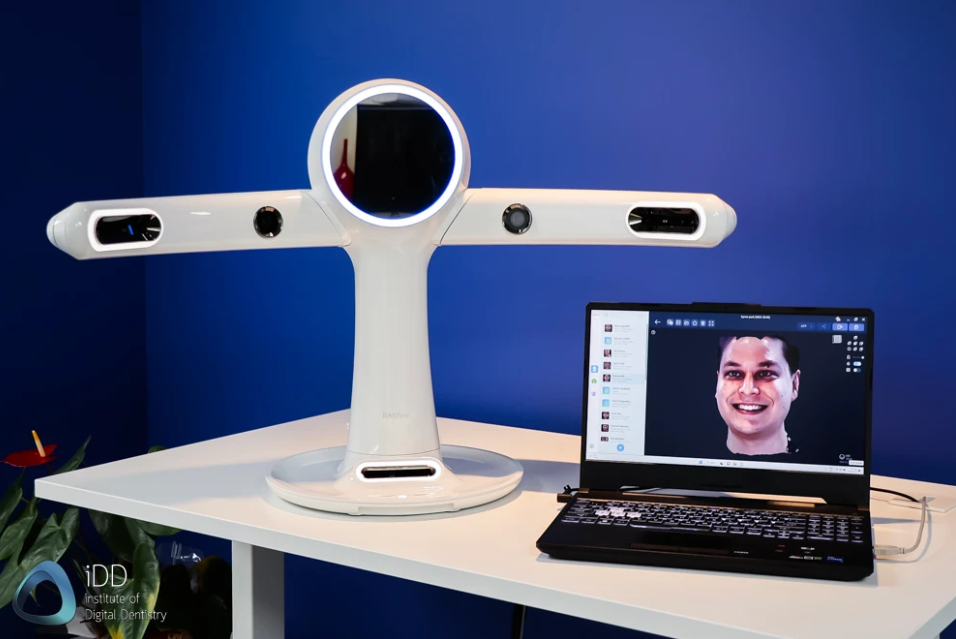
RAYFace (RAY) is a leading desktop scanner and one of the fastest and easiest-to-use scanners made specifically for the dental industry. RAYFace uses six high-resolution cameras and a built-in ring light to take a facial scan. These cameras operate simultaneously to accurately capture the depth of the subject, helping create realistic 3D data. The curvilinear shape of RAYFace removes the need for a separate studio space with lighting and cameras. The ring light is bright enough to enable a clear facial scan, but also safe for the patient’s eyes and skin and does not cause eye fatigue. This means that the user can take a facial scan of the patient with a natural smile, just like taking a photograph.
It is important to note that RAYFace requires calibration every 30 days or if it is moved. A simple calibration tool is attached to it, and the entire process is automated via the software. The user does not have to do much except start the calibration process.
At a cost of around US$20,000, RAYFace is one of the most premium products in this space. It is expensive but also the easiest to use.
ObiScanner 3D facial scanner
ObiScanner (FifthIngenium) is another popular desktop scanner on the market and uses Class 1 laser technology. This means that the laser technology is incapable of producing damaging radiation levels to the patient when in use.
Its external software integration is compatible with any CAD system (including exocad, Dental Wings, 3Shape and Rhinoceros) and with CBCT and intra-oral scanners. The software associated with the scanner allows the user to scan rapid movements performed by the patient, either with a relaxed mouth or smiling such that the teeth are exposed.
At around US$5,000, this is a more economical desktop scanner option. The key difference between this and RAYFace is that RAYFace comes with much better and more sophisticated dental software.
VECTRA M3 3D facial scanner
VECTRA M3 (Canfield Scientific) is a desktop scanner specially designed for the face and neck. Although intended for plastic surgery indications such as rhinoplasty and facial contouring, VECTRA M3 can be used for dental applications.
It is a quite popular product and costs around US$10,000. This was the go-to desktop scanner before RAYFace was designed specifically for dentistry.
Handheld 3D facial scanners
Handheld scanners are like intra-oral scanners, but are used to scan the face. Once capture has been initiated, the device is manually moved around the patient’s face following a defined scanning strategy to build the facial scan. Handheld scanners offer a mobile solution, bringing the technology right to the chairside. They are typically wired but generally lightweight and easy-to-hold devices.
Some dental professionals use their intra-oral scanner as a handheld facial scanner. However, an intra-oral scanner is not fit for this purpose because it can typically only scan around the mouth, scanning takes a long time and an intra-oral scanner cannot capture the face as a whole nor the eyes.
What are the pros of handheld 3D facial scanners?
- Portability: Without a doubt, the lightweight and compact design makes handheld scanners the right choice if you want to use your scanner across different locations. They are easy to carry.
- Cost: The number one benefit is cost. Handheld scanners are much cheaper than desktop scanners.
What are the cons of handheld 3D facial scanners?
- Variable performance: While highly advanced generally, some handheld scanners may not achieve the ultra-high resolution of their desktop counterparts, though this gap is continually narrowing.
- Reduced efficiency: Compared with the one-click operation of desktop scanners, it takes longer to scan the face with handheld scanners. Their scanning speed is becoming faster, but scanning still takes 15–40 seconds, depending on the device.
- Operator error: As with intra-oral scanning, the operator can introduce scanning issues. Therefore, it is vital to have a good scanning strategy in place, and some training is required on the use of the device.
- Patient comfort: It can be challenging for the patient to hold the same smile for more than 5–10 seconds. Some handheld scanners use bright lights that flash constantly, so patients may need to have their eyes closed during the scanning process.
MetiSmile 3D facial scanner
MetiSmile (SHINING 3D) is a handheld scanner developed exclusively for dentistry. The company says that it has an accuracy of 50 μm and a working distance of 500 mm. Using this scanner, the user can take a full-arch scan within about 30 seconds. Additionally, mandibular trajectory tracking will allow dentists to acquire dynamic occlusion data. This upcoming, optional module will include detection of left and right lateral excursions and of centric and open occlusion to deliver detailed occlusal information for accurate diagnosis, design and treatment.
For those currently using SHINING 3D’s Aoralscan 3, you can use the intra-oral scanner to capture the intra-oral data and MetiSmile to capture the facial data. The scanner software then automatically aligns the captured facial scan data and intra-oral scan data.
The cost of MetiSmile is around US$5,000. It does not offer one-click operation, but it is quite a fast scanner.
Thunk3D (InstaRisa 3.0) 3D facial scanner
The original equipment manufacturer Thunk3D scanner, also branded as InstaRisa 3.0, is a powerful, much less expensive alternative to MetiSmile. A three-in-one facial scanner, occlusal scanner and benchtop scanner, the InstaRisa provides an accurate scan of the patient’s face and teeth, eliminating the need for fiducial markers, bite forks or analogue facebows. The facial scan data can be aligned with the intra-oral and CBCT scan data predictably and efficiently, allowing for the accurate use of a virtual articulator in the CAD software.
The InstaRisa scanner sells for around US$19,000, whereas the Thunk3D scanner is only around US$8,000. The Thunk3D scanner comes with less advanced software compared with the InstaRisa version. The main issue is the bright flashing LED lights that make it quite difficult to capture the patient smiling with his or her eyes open. This makes it one of the more difficult scanners to use, but it does have great scan quality.
Face Hunter 3D facial scanner
The Face Hunter (Zirkonzahn) is a handheld scanner used with a laptop. The Face Hunter integrates seamlessly into the Zirkonzahn workflow, providing digitisation with only one click.
POP 3 3D facial scanner
The POP facial scanners (Revopoint) are a line of portable handheld scanners. POP 3 is the company’s next-generation scanner after its POP 2, offering new and improved hardware, design and usability. The improvements in POP 3’s capabilities make capturing facial scans even easier because it uses Class 1 infra-red structured light, dual depth cameras and advanced algorithms to output detailed 3D models.
This is not a dental product, so it does not come with all the features of other dentistry-specific scanners, especially regarding the software. At around US$1,500, it is cheap however.
Phone 3D facial scanners
Phone scanners enable a type of facial scanning using a smartphone rather than a proprietary scanning device. Since the release of the iPhone X (Apple) in 2017, users have been able to securely unlock their phones using Face ID’s biometric technology and the TrueDepth camera. Facial scanning using a phone was popularised by the powerful and easy-to-use Bellus3D iPhone app that utilised the TrueDepth camera. After the company shut down in 2022, it left a void in the facial scanning space for some time until it was filled by RAYFace, MetiSmile and most notably the Qlone app.
What are the pros of phone 3D facial scanners?
- Convenience: Because these scanners run on devices that clinicians likely already own, they make facial scanning accessible anytime, anywhere.
- Cost-effectiveness: The cost of these apps is only around US$20–100 depending on the app. They often offer free trial versions.
- Ease of use: Because most people are familiar with smartphone operations, the time and effort required to learn to use phone scanners is somewhat less than for other handheld devices.
What are the cons of phone 3D facial scanners?
- Accuracy and detail: While impressive for their size, phone scanners typically capture a lower level of detail than specialised 3D facial scanners do.
- Dependence on phone specifications: The quality of the scan can depend heavily on the smartphone’s camera and processing power, which varies widely across devices. A facial scan with an iPhone could differ from a facial scan produced using an Android phone such as from Samsung or Huawei.
- Professionalism: Using a phone for clinical purposes may cast some doubt on professionalism compared with using a purpose-built scanner. But generally this perception is changing, I believe.
- Reduced efficiency: Similar to handheld scanners, these take longer to scan than desktop scanners do. In fact, smartphone scanners take even longer than other handheld scanners, typically about 60–90 seconds per scan.
- Operator error: The operator can introduce scanning issues. Therefore, it is vital to have a good scanning strategy in place, and some training is required on the use of the device.
Qlone
The Qlone iPhone app (EyeCue Vision Technologies) is the newest phone scanner. This app was not designed for dentistry however, but is a 3D object scanner. It works quite well for dentistry, but does not have all the features and integration of dentistry-specific scanners. We have tested it against other 3D facial scanners, and it is accurate.
It does take more time to take a facial scan, owing to a phone having smaller cameras, and I found it generally more technique-sensitive. Although the software needs some refinement, it is difficult to fault it, and it works well overall. Also, it does not capture detail like the more expensive products that I have covered in this article, but it is only US$29.99 and €34.99 in Europe—talk about accessibility! It is much more affordable than anything else on this list.
Key differences between and considerations for 3D facial scanners
When considering investing in and integrating a 3D facial scanner into your practice, there are several factors to take into account to ensure that you select technology that aligns with your dental practice needs and goals.



 Brazil / Brasil
 Canada / Canada
 Latin America / Latinoamérica
 USA / USA
 Austria / Österreich
 Bosnia and Herzegovina / Босна и Херцеговина
 Bulgaria / България
 Croatia / Hrvatska
 Czech Republic & Slovakia / Česká republika & Slovensko
 France / France
 Germany / Deutschland
 Greece / ΕΛΛΑΔΑ
 Hungary / Hungary
 Italy / Italia
 Netherlands / Nederland
 Nordic / Nordic
 Poland / Polska
 Portugal / Portugal
 Romania & Moldova / România & Moldova
 Slovenia / Slovenija
 Serbia & Montenegro / Србија и Црна Гора
 Spain / España
 Switzerland / Schweiz
 Turkey / Türkiye
 UK & Ireland / UK & Ireland
 China / 中国
 India / भारत गणराज्य
 Pakistan / Pākistān
 Vietnam / Việt Nam
 ASEAN / ASEAN
 Israel / מְדִינַת יִשְׂרָאֵל
 Algeria, Morocco & Tunisia / الجزائر والمغرب وتونس
 Middle East / Middle East

 Dr. Mona PatelRegister now1CELive webinar

 Prof. Moritz Kebschull, Cat EdneyRegister now1CELive webinar
 Dr. Jesper Hatt DDSRegister now1CELive webinar
 Dr. med. dent. Henrik-Christian Carl HollayRegister now1CE








To post a reply please login or register