ORLANDO, Fla., US: GPS Digital RPD is a Florida-based dental laboratory specialising in high-quality partial frameworks and flexible partial dentures. Working with a wide range of dental laboratories and practitioners, the company has developed a reputation of quality through utilising the most advanced 3D-printing technologies to improve denture output and accelerate throughput for clients.
Removable partial dentures have grown in popularity as digital technologies have improved. Using a digital workflow, 3D-scan data of a patient’s mouth or of a traditional impression is uploaded to the company’s online portal. From there, the GPS team, led by general manager Joshua Williams, creates a CAD/CAM model ready for printing on the company’s two DMP Flex 200 metal 3D printers and new NextDent 300 MultiJet 3D printer (both 3D Systems).
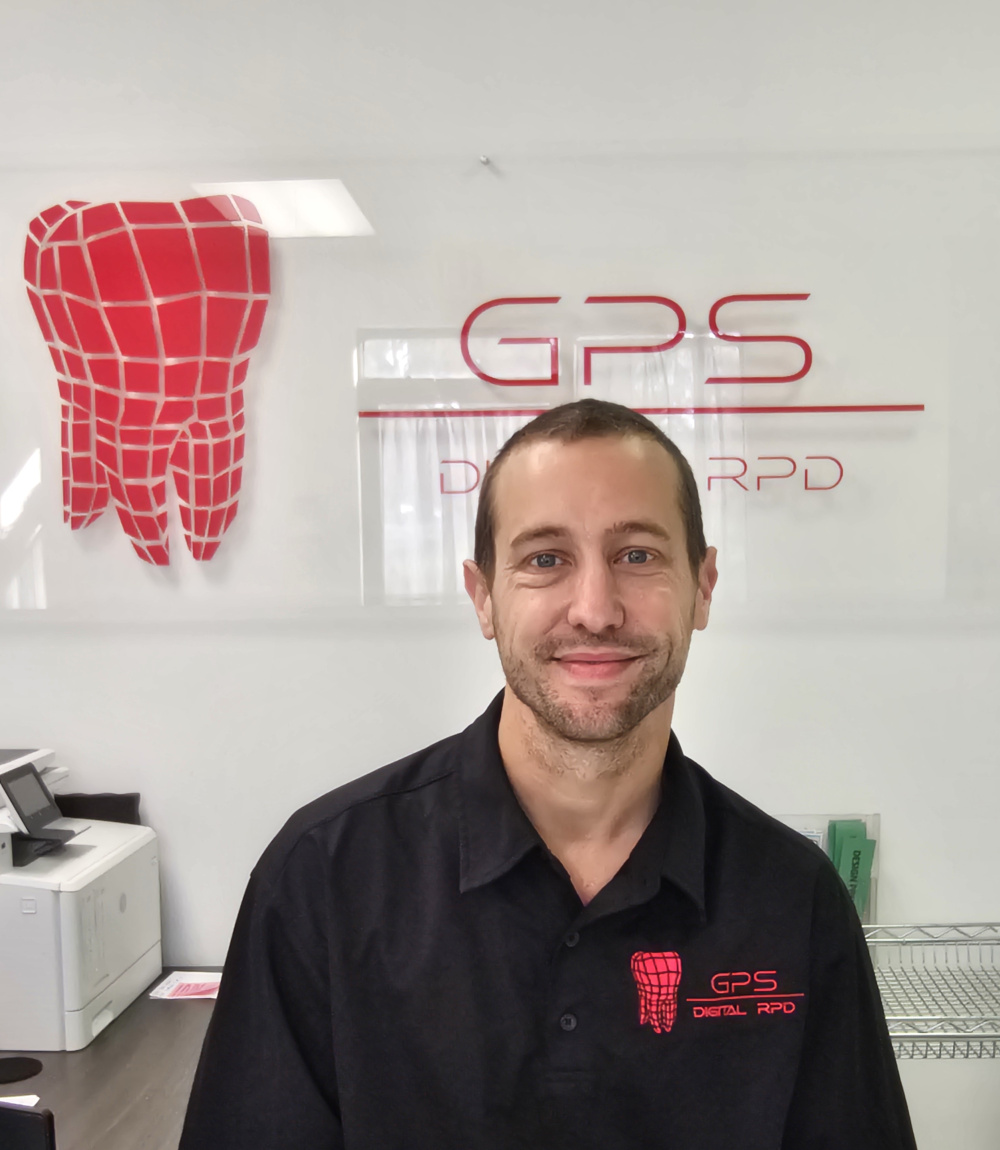
Joshua Williams, general manager of GPS Digital RPD dental laboratory.
DMP Flex 200
Featuring a build volume of 140 × 140 × 115 mm and a 500 W laser source, the DMP Flex 200 leads to reduced costs per part and faster delivery times. Designed for professional manufacturing of small, intricate metal parts, it achieves high-quality output with typical accuracies of ± 50 μm for small metal parts and ± 0.2% for large ones. Part-to-part repeatability is approximately 20 μm. Materials used in the DMP Flex 200 include cobalt–chromium, titanium and 316L stainless steel.
“We are producing about 130 metal frameworks a day now,” said Williams. “Our two DMP Flex 200 systems can keep up with that rate, whereas older machines could not. We do lights-out production, so the team has a whole new set of frameworks to work on every morning.”
Williams was keen to point out that the DMP Flex 200 systems are reliable to leave running overnight and, barring an unanticipated event such as a power outage, deliver very precise output every time. “The output of the DMP Flex 200 is flawless every time,” he said. “We can’t say enough good things about the machine, the software and the quality of parts produced.”
3D-printed metal frameworks just after printing.
3D-printed metal frameworks on the models.
NextDent 300
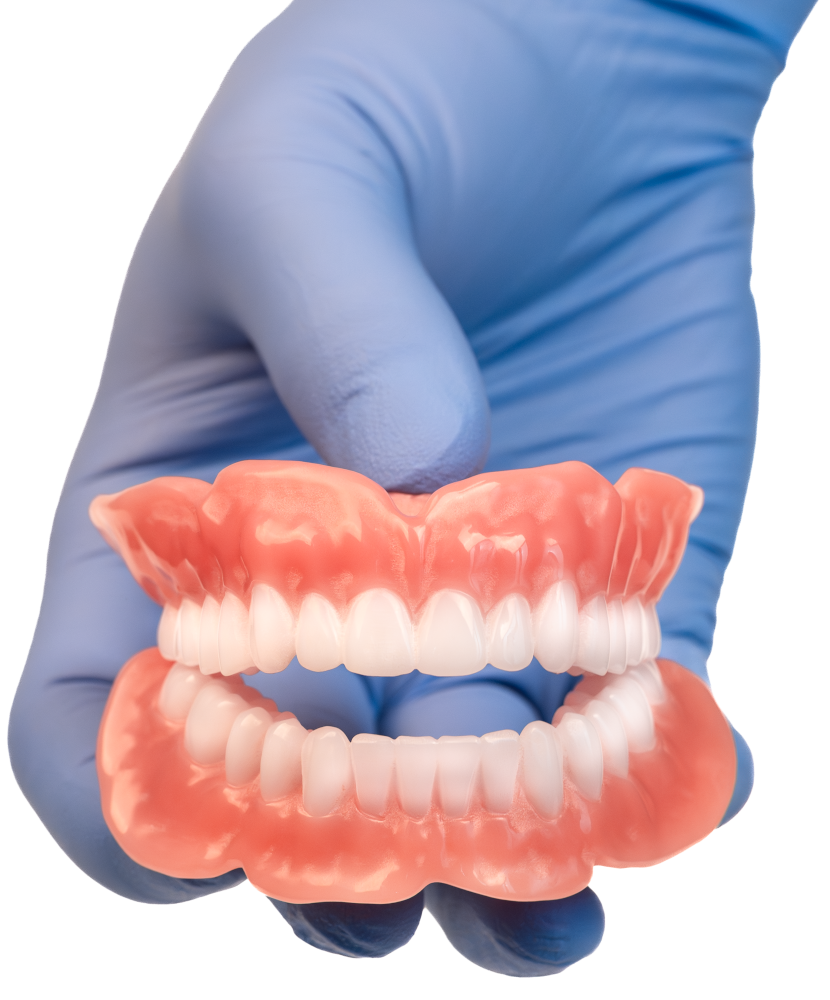
The NextDent 300 produces one-piece removable dental protheses with custom-blended tooth shades. This solution delivers an unparalleled combination of outstanding aesthetics and distinctive fracture resistance. The printer blends polymers on-demand to deliver accurate shade matching. This system is tuned to save time and build productivity for direct denture production by going from CAD data to a multi-material monolithic denture without the need for any additional assembly. It produces patient-ready, highly realistic dentures using biocompatible materials that have US Food and Drug Administration clearance.
3D-printed one-piece removable protheses with custom-blended tooth shades.
“The NextDent 300 printer is a night-and-day difference to alternatives,” said Williams. “There are a lot of patient cases that have very limited space or really awkward shapes, where there is only a few millimetres of space. Handling these cases manually is almost impossible. But this printer makes it easy.”
The multi-material capability of the NextDent 300 allows both the teeth and denture base to be created as a single part. With a build volume of 294 × 211 × 50 mm, it has enough space for an average of 15 dentures in each run. Materials used in the NextDent 300 include:
NextDent Jet Base LT;
NextDent Jet Teeth White;
NextDent Jet Teeth Yellow; and
wax support material.
“The two unique materials and the NextDent 300 make incredibly realistic dentures,” said Williams. “This is way above and beyond the accuracy and output of manual processes, the material colours are nearly perfect and we have zero delamination.”
The team at GPS uses 3Shape’s dental CAD/CAM software, as well as 3D Systems’ 3D Sprint print management software to support this workflow. 3D Sprint manages the 3D printer set-up and operations through tools for nesting parts, for customising tooth shades and for adding flush-with-surface engraving to each part.
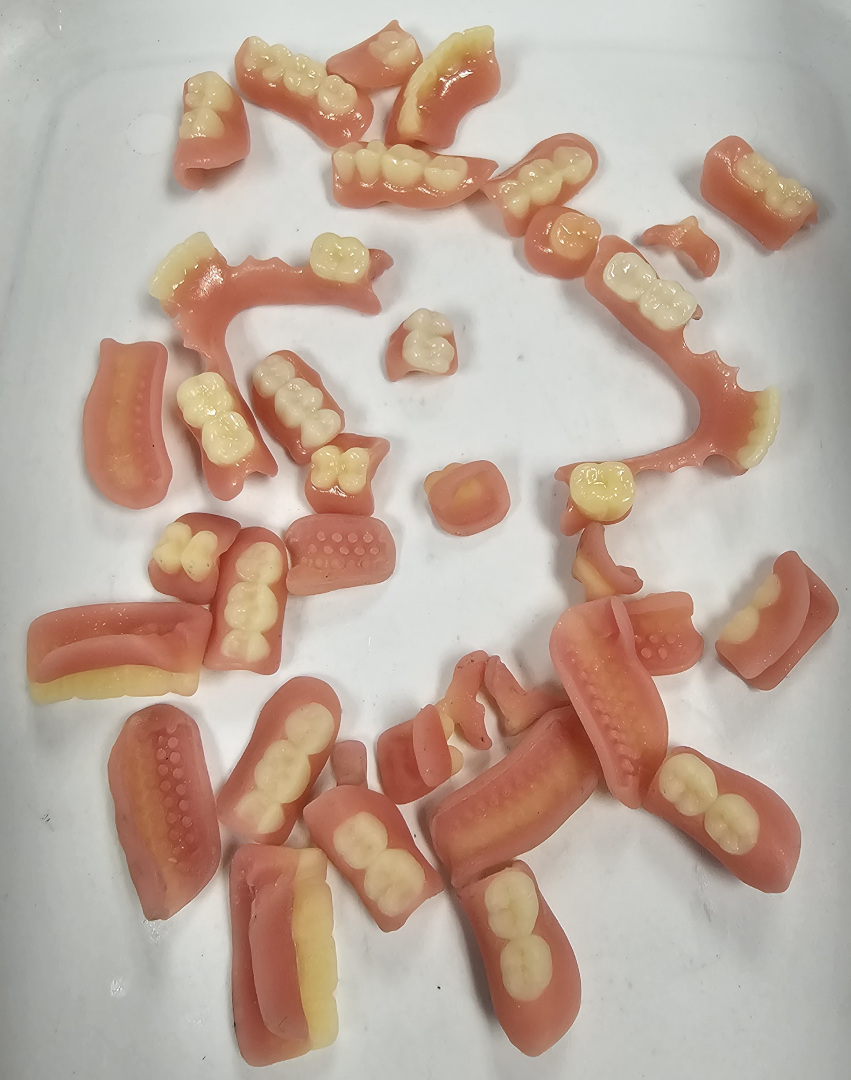
3D-printed resin parts of partial dentures.
3D Sprint
3D Sprint is exclusive software for preparing and optimising CAD and polygon data and managing the 3D-printing process for 3D Systems’ resin 3D printers. “The 3D Sprint software makes all this absurdly easy,” said Williams. “It’s much easier now that the technician doesn’t have to look at 40 partial pieces and wonder, ‘Where do these go?’ Now the labels are added digitally and match to the client reference.”
Once both the frameworks and resin parts have been matched, the team at GPS uses a piece of wax to temporarily combine both pieces. “We send these back to test in the patient’s mouth,” said Williams. “Once they are approved, they come back to us, and we affix them permanently with acrylic and send them back out. It’s really that easy.”
According to Williams, the metal and resin parts are designed to snap together, but the dimples in the metal framework allow for a more permanent attachment with the acrylic. “The holes for retention on the framework act as the alignment for the finished piece,” he said. “There’s no questioning whether it’s lined up; it just fits right in.”
Although GPS has been using digital workflows for removable partial dentures with its DMP Flex 200 printers for nearly three years, the addition of the NextDent 300 signals a new level of productivity for the company. “Our team is far more productive now and this is giving them an opportunity to extend their digital dental skills,” said Williams. “We are always busy, but we encourage the team to cross-train into more digital technologies so that they become even more productive.”
In terms of productivity, Williams maintains that, using this new digital workflow, the team can produce the first finished removable partial dentures to send to the client within nine days, often less. “I could do it within four days, easily, but we always have to factor in Florida storms, power outages and such, so we have to set expectations,” said Williams. “Previously, even with a digital workflow and older 3D printers, the turnaround time was 15 working days, easily. So this is a huge improvement, not only in production time but with visibly improved quality and fit.”
LEEDS, UK: In a recent study, researchers have examined whether the use of removable partial dentures has an impact on the long-term survival outcomes of ...
NEW YORK, U.S.: In an upcoming, free Dental Tribune Study Club webinar on Wednesday, Feb. 27, an expert will be introducing Ultaire AKP removable partial ...
DARMSTADT, Germany: Exocad, an Align Technology company and a leading dental CAD/CAM software provider, has announced the release of PartialCAD 3.2 ...
The main problem that brings patients to our surgery is an edentulous maxilla, which motivates the patient to want a functional restoration, with particular...
SOMERVILLE, Mass., US: 3D printing expert Formlabs has announced its new Form 4BL, a large-format 3D printer empowering dental professionals to meet the ...
SOMERVILLE, Mass., U.S.: Formlabs has launched a new indirect bonding tray (IBT) resin that it says will bring the benefits of 3D printing to orthodontic ...
General dental practitioner Dr Graham Stokes, who is chair of the MPS Foundation, a global not-for-profit research initiative, will be among this year’s ...
SHEFFIELD, UK: In a first-of-its-kind study, researchers from the University of Sheffield have investigated patients’ emotional challenges in being ...
Modern endodontics is no longer an isolated discipline. It marks the start of a restorative process that extends all the way to the final composite layer. ...
Within dentistry, what once involved a small number of independent systems now increasingly relies on continuous connectivity between devices, software ...
DARMSTADT, Germany: Exocad, an Align Technology company and a leading dental CAD/CAM software provider, today announced extended programme details for ...



 Brazil / Brasil
 Canada / Canada
 Latin America / Latinoamérica
 USA / USA
 Austria / Österreich
 Bosnia and Herzegovina / Босна и Херцеговина
 Bulgaria / България
 Croatia / Hrvatska
 Czech Republic & Slovakia / Česká republika & Slovensko
 France / France
 Germany / Deutschland
 Greece / ΕΛΛΑΔΑ
 Hungary / Hungary
 Italy / Italia
 Netherlands / Nederland
 Nordic / Nordic
 Poland / Polska
 Portugal / Portugal
 Romania & Moldova / România & Moldova
 Slovenia / Slovenija
 Serbia & Montenegro / Србија и Црна Гора
 Spain / España
 Switzerland / Schweiz
 Turkey / Türkiye
 UK & Ireland / UK & Ireland
 China / 中国
 India / भारत गणराज्य
 Pakistan / Pākistān
 Vietnam / Việt Nam
 ASEAN / ASEAN
 Israel / מְדִינַת יִשְׂרָאֵל
 Algeria, Morocco & Tunisia / الجزائر والمغرب وتونس
 Middle East / Middle East

 Dr. John Flucke DDSWatch recording1CELive webinar
 Dr. João AbreuLive webinar
 Dr. Laurence Adriaens, Dr. Ghida Lawand BDS, MScRegister now1CELive webinar
 Prof. Carla ZogheibRegister now1CE














To post a reply please login or register