According to lecturer and researcher Dr Mehmood Asghar Bhatti, UK dental education risks falling behind contemporary clinical practice unless minimally invasive dentistry is embedded at the core of undergraduate training. (Image: FS-Stock/Adobe Stock)
Despite rapid advancements in digital cariology and biomaterials, a translation gap remains between modern clinical capabilities and resources and the foundational training provided to UK dental students. This commentary explores whether current UK dental curricula are adequately preparing the next generation of practitioners to pursue minimally invasive dentistry (MID) over traditional surgical intervention.
The philosophy of MID has fundamentally redefined modern oral healthcare. Over the years, dental professionals realised that the traditional surgical and restorative approach, rooted in G.V. Black’s “extension for prevention”, had become financially non-viable and was putting immense pressure on global healthcare systems.1 This led to a shift from the surgical model of caries management to a conservative one.2 This modern framework prioritises risk assessment, early detection, remineralisation and defect-driven conservative preparation. However, as the dental profession transitions towards this preventive mandate, a critical question has arisen: is undergraduate dental education in the UK keeping abreast of contemporary clinical realities?
The current landscape suggests a noticeable disconnect between contemporary knowledge and foundational training. This knowledge gap was addressed in a study published in the British Dental Journal.3 The study revealed that only 28% of the UK general dental practitioners surveyed accurately responded to the three basic scenarios posed in relation to contemporary MID. Furthermore, while 58% of respondents reported having some knowledge on MID, only 11% reported knowing a great deal.
More concerning is the systemic nature of this educational lag. Most dental curricula either lack undergraduate-level teaching on MID or do not emphasise its importance in contemporary clinical dentistry enough.
A recent publication by Santamaría et al. summarised the university- and country-level challenges faced regarding the implementation of the Core Curriculum in Cariology, developed by the European Organisation for Caries Research.4 The study showed that 73% of the participants agreed that caries management in participating universities was still centred primarily on traditional surgical and restorative protocols in all dental specialties, instead of MID. Moreover, 96.0% of respondents agreed on the need to implement a standard Core Curriculum in Cariology, while 93.7% agreed that getting all universities in their country to adopt such a curriculum remained very challenging.
“The current landscape suggests a noticeable disconnect between contemporary knowledge and foundational training.”
Since dental students are not exposed to the MID philosophy during undergraduate training, they continue to follow the drill-and-fill ideology during clinical practice. This often necessitates fresh graduates to undergo additional training programmes to align with the contemporary caries management strategies. This is evident from the recently launched MSc degree programme on MID by Queen Mary University of London. The programme’s official description states that “MID bridges the traditional gap between prevention and surgical procedures”.5 This clearly signifies the gap between contemporary knowledge on MID and the traditional surgical and restorative training that is being imparted to our students at the undergraduate level.
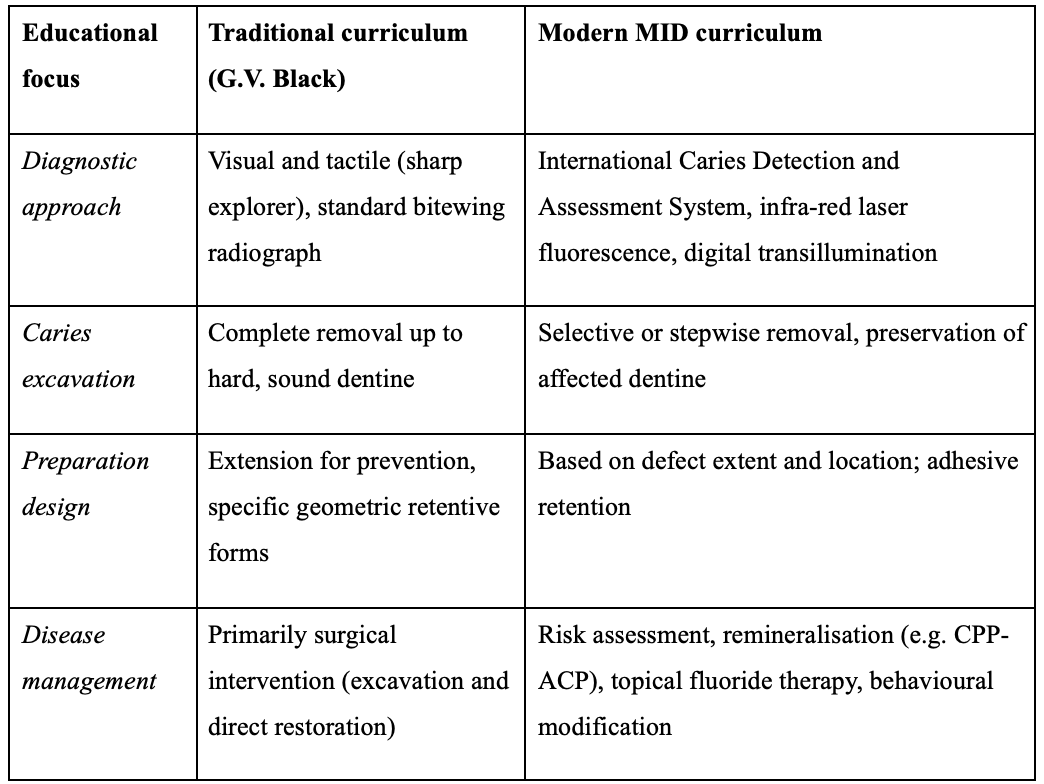
This educational lag is most evident in the realm of diagnostics. While modern clinical practice increasingly relies on advanced diagnostic adjuncts such as infra-red laser fluorescence, electrical caries monitors and the International Caries Detection and Assessment System, many curricula still heavily emphasise traditional visual and tactile examination. The continued reliance on the sharp dental explorer—an instrument shown to potentially cause iatrogenic damage to remineralising enamel—exemplifies the delayed adoption of contemporary evidence-based practices.
Table 1: The paradigm shift in caries management training.
Similar discrepancies exist in biomaterials science and operative techniques. The contemporary clinician utilises fluoride products, bioactive materials, casein phosphopeptide-amorphous calcium phosphate (CPP-ACP), and selective or stepwise caries removal protocols to preserve pulp vitality. Many practitioners are now using topical remineralising agents such as silver diamine fluoride to implement MID (Table 1). However, dental students often spend a disproportionate number of preclinical hours mastering standardised geometric cavity preparations dictated by the mechanical requirements of traditional restorative materials rather than the biological limits of the tooth.
The implications of this translation gap extend beyond the classroom. Patient expectations have evolved; the modern public expects tissue-preserving and preventive care. The continued teaching of the traditional treatment model directly affects the decision-making process of future dental practitioners.
A 2025 multinational survey clearly illustrated this issue.6 When presented with clinical scenarios of deep carious lesions in young patients, the majority of undergraduate dental students defaulted to the traditional, highly invasive non-selective caries removal protocol rather than relying on MID principles. Alarmingly, for both young and older symptomatic patients, these undergraduates tended to opt for maximum surgical intervention, such as complete pulpectomies and root canal treatments. Postgraduate students—those who had undergone advanced, secondary training—more often applied conservative, age-appropriate vital pulp therapies.
This stark contrast reflects the ongoing need to update undergraduate dental curricula and indicates that foundational training is failing to embed modern biological logic. Furthermore, as National Health Service dental contracts increasingly signal a shift towards preventive pathways and risk-based care, new graduates must enter the workforce equipped with a firm grasp of minimally invasive protocols. If newly qualified practitioners lack confidence in non-operative caries management or selective excavation, the default inevitably becomes overtreatment.
To bridge this divide, it is high time that dental institutions actively transition from a purely surgical mindset to a preventive, disease management model of care. Integrating comprehensive MID protocols into the core of undergraduate curricula—rather than offering them as postgraduate afterthoughts—is essential for the future of patient care. Dental students should spend more time learning the contemporary, non-invasive caries management strategies instead of practising the traditional, outdated treatment protocols.
Role models shape how dental students see the profession, their own potential and even their well-being. In a recent British Dental Journal special feature ...
AMSTERDAM, Netherlands: According to a new cross-sectional study, dental professionals and students in the Netherlands are broadly positive about the role ...
AL-NABEK, Syria: Years of conflict have left deep psychological scars on Syria’s future healthcare workforce. New research among health sciences students ...
LEIPZIG, Germany: A recent expert review has set out evidence-based consensus recommendations to help dental teams in the Middle East and Africa (MEA) ...
Antimicrobial resistance is a mounting global health threat, and dentistry accounts for a notable share of antibiotic use. In conflict-affected settings ...
Education
Live webinar Tue. 24 March 2026 1:00 pm EST (New York)



 Brazil / Brasil
 Canada / Canada
 Latin America / Latinoamérica
 USA / USA
 Austria / Österreich
 Bosnia and Herzegovina / Босна и Херцеговина
 Bulgaria / България
 Croatia / Hrvatska
 Czech Republic & Slovakia / Česká republika & Slovensko
 France / France
 Germany / Deutschland
 Greece / ΕΛΛΑΔΑ
 Hungary / Hungary
 Italy / Italia
 Netherlands / Nederland
 Nordic / Nordic
 Poland / Polska
 Portugal / Portugal
 Romania & Moldova / România & Moldova
 Slovenia / Slovenija
 Serbia & Montenegro / Србија и Црна Гора
 Spain / España
 Switzerland / Schweiz
 Turkey / Türkiye
 UK & Ireland / UK & Ireland
 China / 中国
 India / भारत गणराज्य
 Pakistan / Pākistān
 Vietnam / Việt Nam
 ASEAN / ASEAN
 Israel / מְדִינַת יִשְׂרָאֵל
 Algeria, Morocco & Tunisia / الجزائر والمغرب وتونس
 Middle East / Middle East

 Dr. Andrea BazzucchiLive webinar
 Prof. Sérgio André QuaresmaRegister now1CELive webinar
 Dr. John Flucke DDSRegister now1CELive webinar
 Dr. João Abreu










To post a reply please login or register