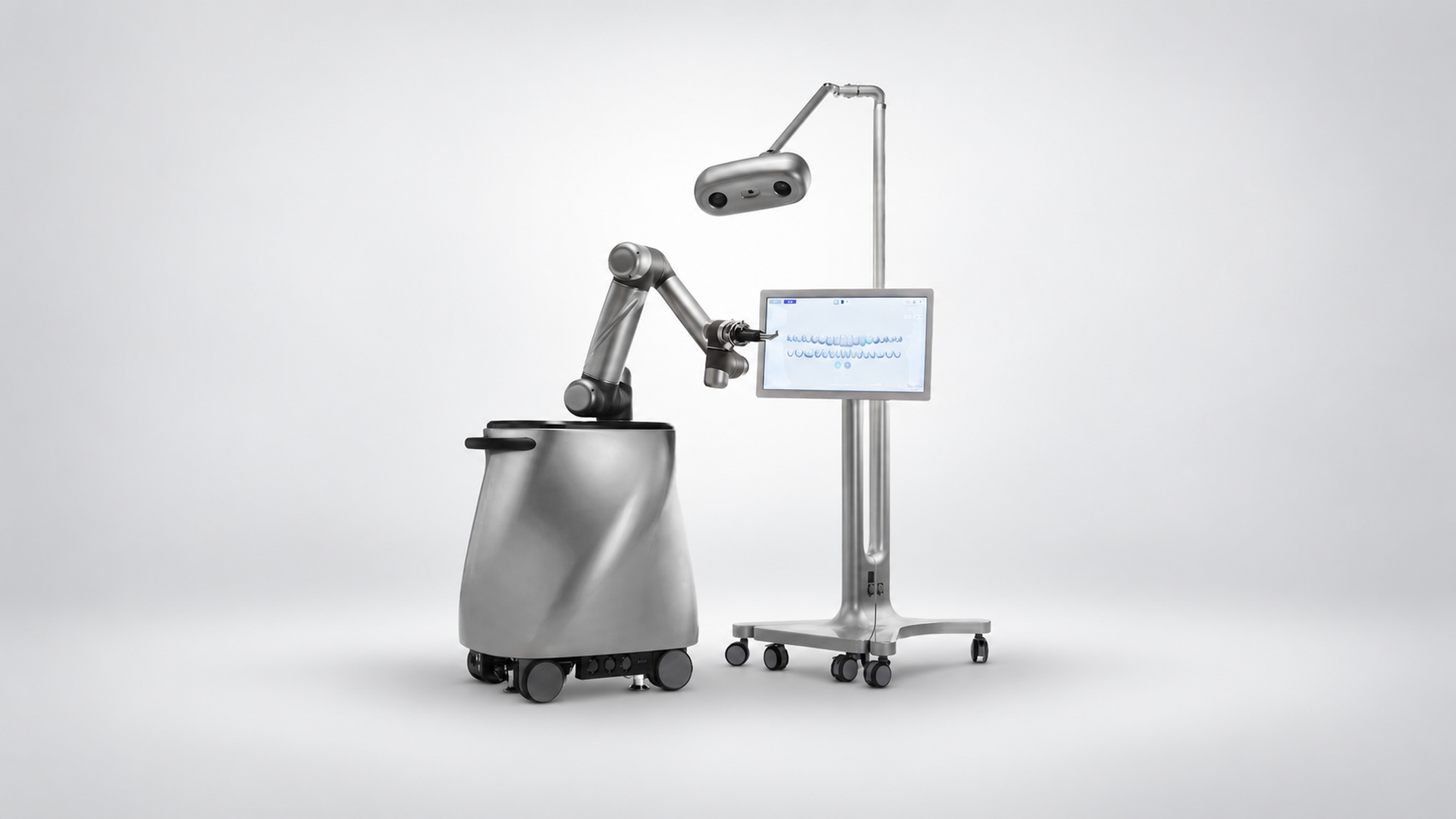
“Our team has worked in autonomous dental implant robotics for many years. However, an implant robot can essentially prepare only a circular osteotomy along a single straight-line path,” co-author Prof. Shizhu Bai of the School of Stomatology at the Air Force Medical University told Dental Tribune International. “The starting point of our study was to break through the single straight-line path limitation of implant robots,” Prof. Bai said. “We wanted to upgrade the robot from precise positioning to precise morphological replication.”
The study used 40 3D-printed mandibular models representing tooth autotransplantation scenarios. Twenty underwent robot-assisted preparation and 20 static tooth-supported guide-assisted preparation. Each group included ten single-rooted and ten double-rooted anatomies. Planning software was used to position the donor teeth and design the recipient socket geometry.
According to the findings, the robotic system achieved greater positional accuracy at depth and more closely reproduced the planned socket geometry than the static guide-assisted approach, particularly in double-rooted models. Mean deviation at the socket entry point was comparable between the groups, whereas mean apical deviation was significantly lower with robotic preparation. Mean angular deviation was also lower.
Prof. Bai argued that this advantage becomes increasingly relevant as anatomical complexity increases: “When a procedure requires simultaneously considering the concavities, bifurcations and interdental bone preservation of multiple roots, human cognitive load approaches its limit—yet the robot handles it with ease.”
Robot-prepared sockets showed greater volumetric agreement with the planned geometry and substantially less bone removal beyond the planned volume. Commenting on the high over-removal rate recorded for the static guide-assisted workflow, Prof. Bai said: “The guide group’s over-removal rate reflects a simple fact: when faced with complex morphology, surgeons instinctively remove a little more bone to make sure that the tooth will fit. This over-preparation, undertaken in the name of safety, is precisely what compromises the root–socket fit required for periodontal ligament healing. The robot, by contrast, avoids this cycle of repeated trial fitting and adjustment.”
Importantly, socket preparation time did not differ significantly between the groups overall. However, clinical studies will be needed to determine whether the improvements in geometric accuracy translate into shorter extra-alveolar time, improved transplant stability, favourable healing and better long-term outcomes.



 Brazil / Brasil
 Canada / Canada
 Latin America / Latinoamérica
 USA / USA
 Austria / Österreich
 Bosnia and Herzegovina / Босна и Херцеговина
 Bulgaria / България
 Croatia / Hrvatska
 Czech Republic & Slovakia / Česká republika & Slovensko
 France / France
 Germany / Deutschland
 Greece / ΕΛΛΑΔΑ
 Hungary / Hungary
 Italy / Italia
 Netherlands / Nederland
 Nordic / Nordic
 Poland / Polska
 Portugal / Portugal
 Romania & Moldova / România & Moldova
 Slovenia / Slovenija
 Serbia & Montenegro / Србија и Црна Гора
 Spain / España
 Switzerland / Schweiz
 Turkey / Türkiye
 UK & Ireland / UK & Ireland
 China / 中国
 India / भारत गणराज्य
 Pakistan / Pākistān
 Vietnam / Việt Nam
 ASEAN / ASEAN
 Israel / מְדִינַת יִשְׂרָאֵל
 Algeria, Morocco & Tunisia / الجزائر والمغرب وتونس
 Middle East / Middle East

 Dr. Ahmed ElmoghazyLive webinar
 Dr. Gil Asafrana D.M.D, B.M.ScRegister now1CELive webinar
 Dr. Adrian Gnatek PhD | Oral SurgeonRegister now1CELive webinar
 Rayna StrongRegister now1CE










To post a reply please login or register