Dentine density and tubule porosity vary markedly across the tooth, especially towards the pulp, and although zinc was already known to increase in this direction, it had not been systematically quantified across entire intact teeth or directly related to these structural gradients.
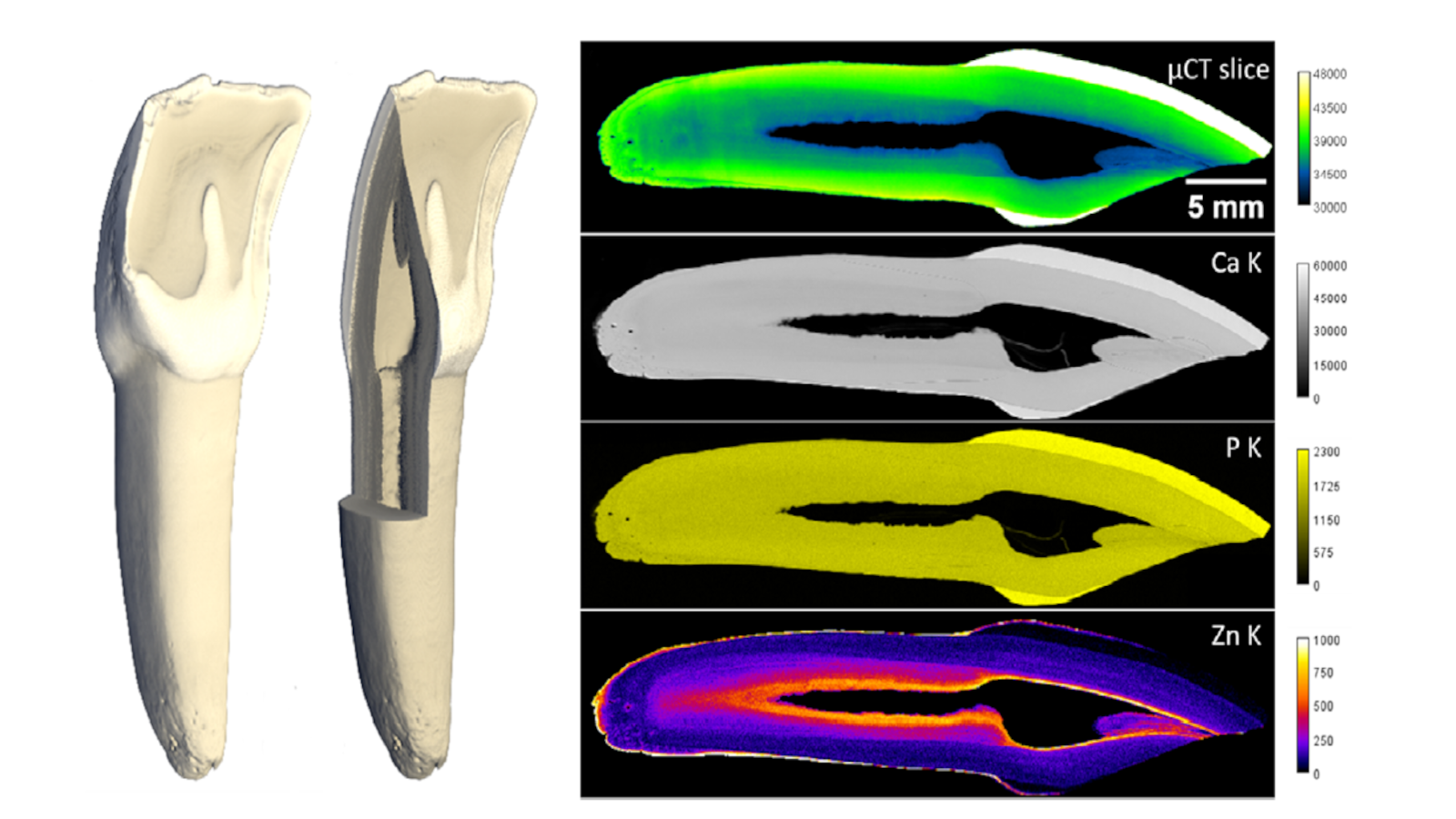
To investigate how chemistry relates to dentine structure and establish a baseline for comparison in future studies of disease and restorative treatment, the researchers combined micro-CT with quantitative micro-X-ray fluorescence imaging and used healthy, intact teeth. The CT scans provided a 3D map of dentine density and dentinal tubule distribution, while the fluorescence technique measured the concentration of elements such as calcium, phosphorus and zinc throughout the tooth.
The results showed that calcium and phosphorus were distributed relatively uniformly across the tissue. Zinc, however, followed a striking gradient. Its concentration increased fivefold to tenfold from the denser outer regions of dentine towards the pulp. The finding that zinc concentration rose as dentine density decreased suggests that the element is localised in or around the dentinal tubules. The researchers therefore proposed that some of the zinc may be associated more with the collagen-rich dentinal tissue in or around dentinal tubules, possibly along with naturally occurring enzymes, and that when deep dentine is demineralised—for example by caries or acid etching—this zinc may become mobile and contribute to enzymatic collagen breakdown.
The findings could thus have implications for clinical dentistry. Since zinc is widely used in dental materials, understanding the natural distribution of zinc in dentine may help researchers evaluate how such materials interact with tooth tissue and whether they influence enzymatic processes involved in dentine degradation, having possible implications for bond durability.
Speaking in a press release, co-author of the study Prof. Paul Zaslansky, laboratory head at the Department of Operative, Preventive and Paediatric Dentistry of Charité—Universitätsmedizin Berlin, explained that the results are highly relevant to improving dental care, for example when deciding whether the dentist should recommend materials with a low or high zinc content during treatment. He added that studies on human teeth are needed to confirm the study’s findings from bovine teeth.
The researchers also suggested that zinc could serve as a sensitive indicator of structural changes in mineralised tissue mineral density changes. Because its distribution closely correlates with dentine porosity, mapping zinc may provide a new way to monitor variations in tissue density linked to ageing, disease or dental treatments.
Prof. Zaslansky concluded: “We found unexpectedly that zinc may serve as a very sensitive indicator of gradient in material density, which can change over the lifetime. Density is linked to mechanical competence of mineralised tissue and should be neither too high nor too low for proper tissue function. Using high-sensitivity methods such as X-ray fluorescence, we may be able to analyse samples and monitor density changes associated with ageing, for example in response to well-chosen restorative materials or oral pastes.”
The article, titled “Quantitative micro-XRF combined with X-ray imaging reveals correlations between Zn concentration and dentin tubule porosity across entire teeth”, was published online on 19 January 2026 in VIEW, ahead of inclusion in an issue.



 Brazil / Brasil
 Canada / Canada
 Latin America / Latinoamérica
 USA / USA
 Austria / Österreich
 Bosnia and Herzegovina / Босна и Херцеговина
 Bulgaria / България
 Croatia / Hrvatska
 Czech Republic & Slovakia / Česká republika & Slovensko
 France / France
 Germany / Deutschland
 Greece / ΕΛΛΑΔΑ
 Hungary / Hungary
 Italy / Italia
 Netherlands / Nederland
 Nordic / Nordic
 Poland / Polska
 Portugal / Portugal
 Romania & Moldova / România & Moldova
 Slovenia / Slovenija
 Serbia & Montenegro / Србија и Црна Гора
 Spain / España
 Switzerland / Schweiz
 Turkey / Türkiye
 UK & Ireland / UK & Ireland
 China / 中国
 India / भारत गणराज्य
 Pakistan / Pākistān
 Vietnam / Việt Nam
 ASEAN / ASEAN
 Israel / מְדִינַת יִשְׂרָאֵל
 Algeria, Morocco & Tunisia / الجزائر والمغرب وتونس
 Middle East / Middle East

 Dr. Shizuma ShibataLive webinar
 Dr. Matthias RzeznikRegister now1.5CELive webinar
 Dr. Mona PatelRegister now1CELive webinar

 Prof. Moritz Kebschull, Cat EdneyRegister now1CE












To post a reply please login or register