The reverse evidence-based dentistry pathway
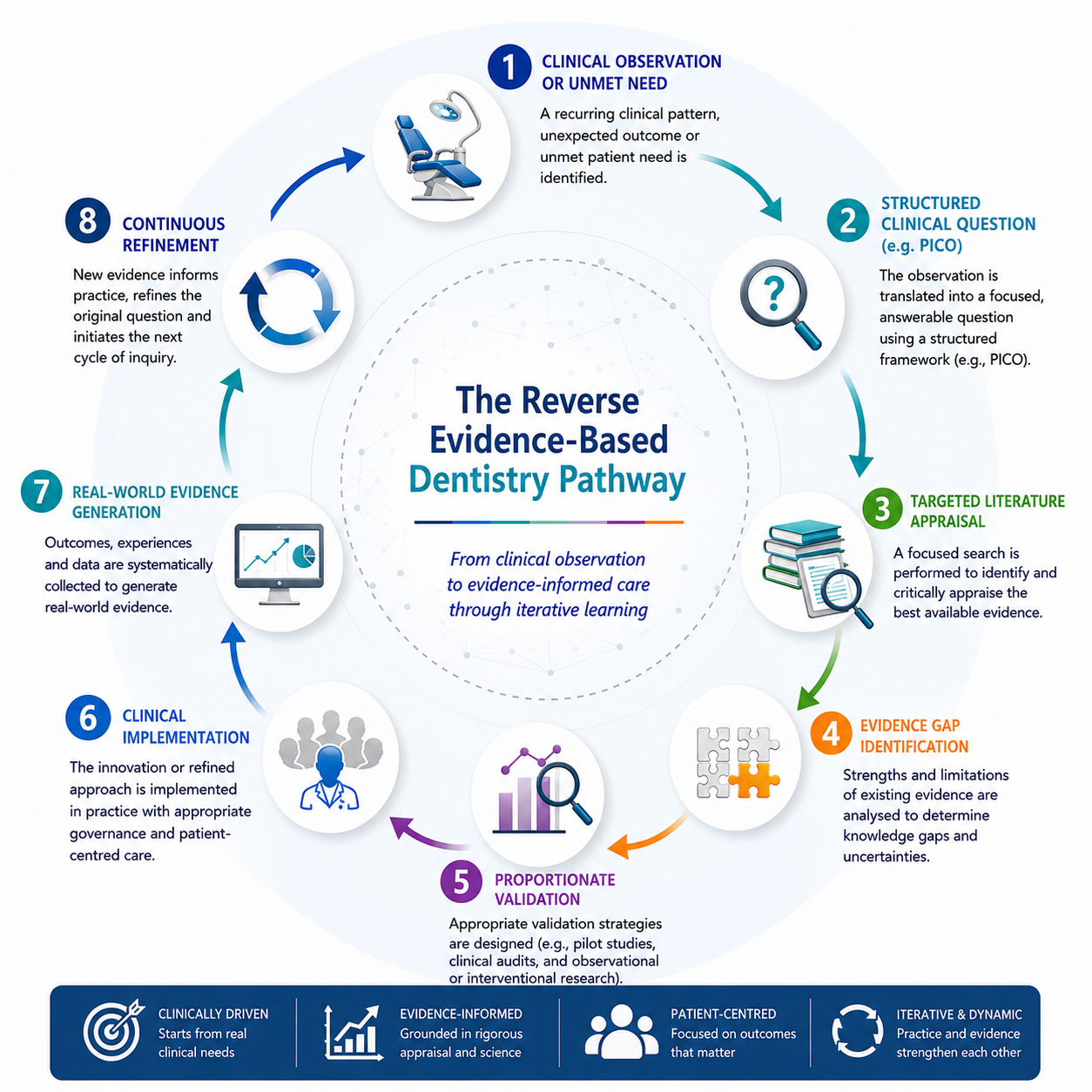
The reverse evidence-based dentistry pathway provides a structured methodology for transforming recurring clinical observations or unmet clinical needs into scientifically testable questions (Fig. 1). It begins with the identification of a reproducible clinical observation or an unmet clinical need. This initial insight is translated into a structured clinical question, followed by a focused appraisal of the available scientific literature. Rather than viewing clinical experience as an end-point, the pathway treats it as the beginning of a systematic process aimed at generating robust evidence and improving future patient care.8, 1, 6
Existing evidence is critically evaluated not only to identify what is already known, but also to determine where meaningful knowledge gaps remain.8, 6 At this stage, the objective is not merely to identify supporting evidence, but also to recognise uncertainty, conflicting findings and areas where additional validation is required.
These gaps guide the design of appropriate validation strategies, which may include structured clinical audits, real-world observational studies and prospective clinical investigations, depending on the maturity of the available evidence and the complexity of the clinical question. The objective is not to accelerate adoption prematurely, but to ensure that innovation progresses through transparent and scientifically appropriate validation pathways.1, 2 The extent and rigour of the validation required should be proportionate to the level of uncertainty and the potential impact of the innovation on patient care.
Importantly, the reverse evidence-based dentistry pathway is iterative rather than linear. Evidence generated through clinical implementation continuously informs subsequent observations, refines existing hypotheses and stimulates new cycles of investigation. In this way, everyday clinical practice becomes both a source and a beneficiary of continuous evidence generation, reinforcing the dynamic relationship between observation, validation and responsible innovation.8, 1, 6
“The practical value of reverse evidence-based dentistry becomes evident when applied to everyday clinical decision-making across different areas of dental practice.”
From clinical questions to measurable evidence
The practical value of reverse evidence-based dentistry becomes evident when applied to everyday clinical decision-making across different areas of dental practice. Regardless of the clinical context, the underlying process remains the same: a recurring observation generates a focused question, existing evidence is critically appraised, knowledge gaps are identified and appropriate validation strategies are developed before changes are introduced into routine care.8, 1, 6, 7, 2
In periodontal care, for example, clinical parameters such as probing depth or bleeding on probing describe disease status, but may not fully reflect the patient’s overall inflammatory burden. Integrating measures such as the periodontal inflamed surface area with high-sensitivity measurement of systemic inflammatory biomarkers like C-reactive protein has been proposed as a broader framework for understanding the biological relationship between periodontal inflammation and systemic health.6, 9, 10, 11
The same reasoning is relevant in digital dentistry and artificial intelligence. Artificial intelligence systems can rapidly generate clinically relevant outputs, including diagnostic support, treatment suggestions and predictive models. However, these outputs should be interpreted as decision support tools rather than substitutes for professional judgement. By encouraging clinicians to question how recommendations were generated, what evidence supports them and where uncertainties remain, reverse evidence-based dentistry reinforces critical appraisal instead of unquestioning acceptance.1, 2
A similar approach applies to emerging biomaterials, preventive strategies, regenerative therapies and digital workflows. Rather than beginning with product claims or technological novelty, responsible innovation should begin with clearly identified clinical needs, followed by systematic appraisal of the evidence and proportionate validation of the proposed innovation before wider implementation.1, 3, 12



 Brazil / Brasil
 Canada / Canada
 Latin America / Latinoamérica
 USA / USA
 Austria / Österreich
 Bosnia and Herzegovina / Босна и Херцеговина
 Bulgaria / България
 Croatia / Hrvatska
 Czech Republic & Slovakia / Česká republika & Slovensko
 France / France
 Germany / Deutschland
 Greece / ΕΛΛΑΔΑ
 Hungary / Hungary
 Italy / Italia
 Netherlands / Nederland
 Nordic / Nordic
 Poland / Polska
 Portugal / Portugal
 Romania & Moldova / România & Moldova
 Slovenia / Slovenija
 Serbia & Montenegro / Србија и Црна Гора
 Spain / España
 Switzerland / Schweiz
 Turkey / Türkiye
 UK & Ireland / UK & Ireland
 China / 中国
 India / भारत गणराज्य
 Pakistan / Pākistān
 Vietnam / Việt Nam
 ASEAN / ASEAN
 Israel / מְדִינַת יִשְׂרָאֵל
 Algeria, Morocco & Tunisia / الجزائر والمغرب وتونس
 Middle East / Middle East

 Dr. Sinan GhishanRegister now1CELive webinar
 Dr. Sonia PresenciaLive webinar
 Dr. John Tsourounakis DDS, Cert. Perio, MS, FRCD(C)Register now1CELive webinar

 Dr. Varkha Rattu, Cat EdneyRegister now1CE










To post a reply please login or register