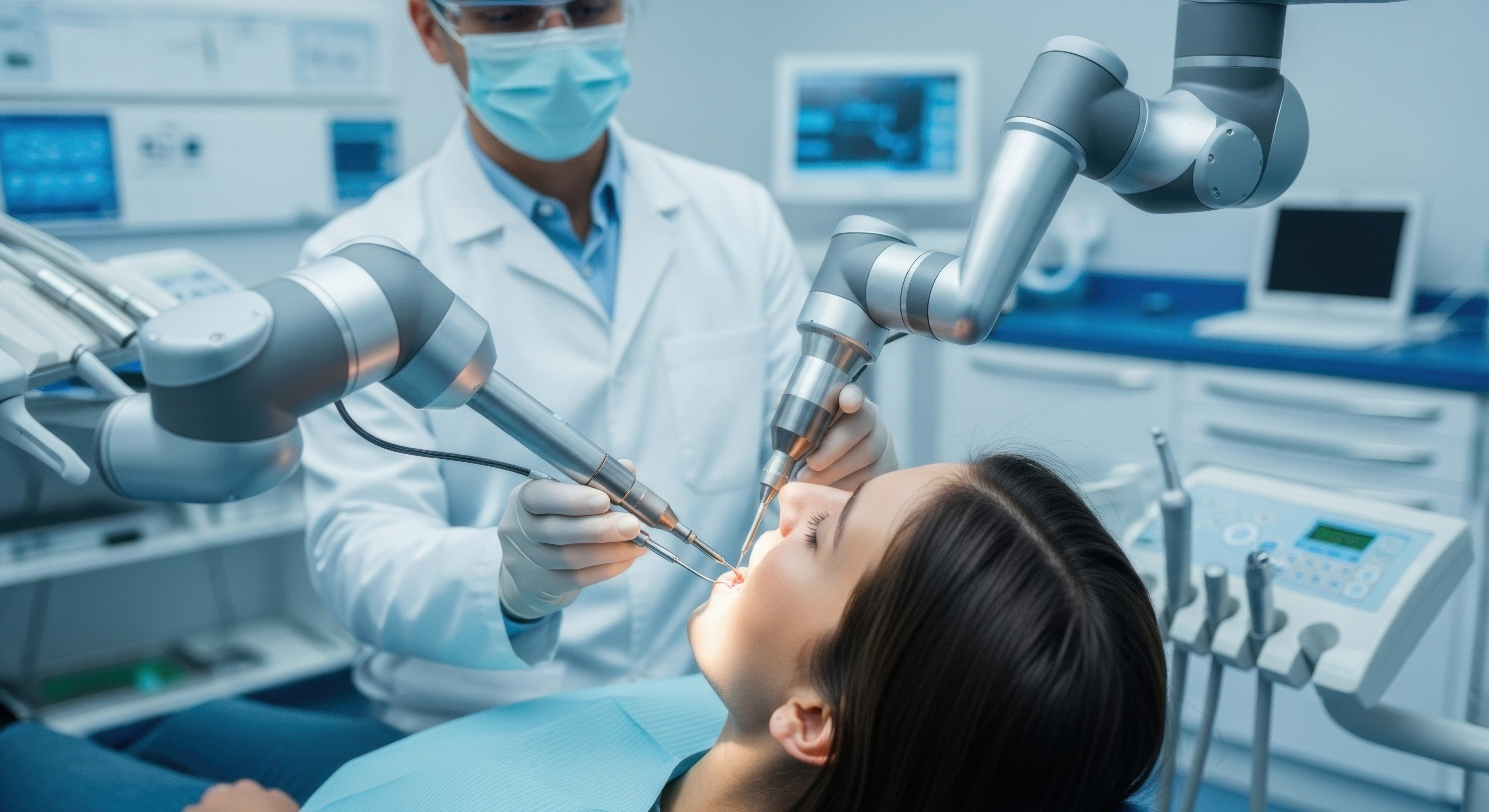
A new review has underscored that robotic platforms within dentistry achieve the greatest precision in implant placement compared with other computer-assisted techniques. (Image: Dmitry/Adobe Stock)
LEIPZIG, Germany: Robotic computer-assisted technologies are beginning to reshape dental implant surgery, although their use remains limited. A recent review has explained and compared dynamic navigation and robotic systems to offer guidance to practitioners regarding the digital future of implant dentistry. When the article is read alongside relevant literature, the evidence suggests that robotic systems are promising but at an early stage, supporting clinicians rather than replacing them.
Compared with static computer-assisted implant surgery systems, dynamic navigation systems already represent an important step towards more automated workflows. Robotic systems build on the real-time guidance provided by dynamic navigation systems by introducing automated or semi-automated osteotomy preparation. The robotic system can stabilise the drill and guide its movement based on the preoperative digital plan. The clinician remains responsible for supervising the process and initiating the relevant steps, but the robotic system helps maintain precision and stability during osteotomy preparation and implant insertion.
Prof. Michael Bornstein, head of the clinic for oral health and medicine at the University of Basel’s dental school in Switzerland. (Image: Prof. Michael Bornstein)
Even as these technologies develop, experts emphasise that implant surgery remains firmly under human control. Co-author of the review Prof. Michael Bornstein, who is head of the clinic for oral health and medicine at the University of Basel’s dental school in Switzerland, noted to Dental Tribune International: “We always must be open to the not-yet-invented technology that might change everything. Robotic implant surgery might be altered dramatically in a short period, and we have seen the speed of innovation clearly increase over the last two decades. Ideally, we would see more surgical time taken over by the robot and the clinician being sort of a pilot or supervisor.”
“Nevertheless, the pilot also needs to be able to take over when the robot malfunctions,” Prof. Bornstein continued. For this reason, “for the foreseeable future, the surgeon must be able to do the entire surgery himself or herself without relying on artificial intelligence and robotic technology,” he said.
“We always must be open to the not-yet-invented technology that might change everything.”
A systematic review published recently in Dentistry Journal provides additional guidance for clinicians on the accuracy of dynamic and robotic computer-assisted implant placement compared with static guidance and freehand placement. Overall, the findings suggest that both navigation systems and robotic platforms can achieve high levels of positional accuracy, particularly in terms of angulation and depth. This high accuracy is one of the main drivers behind the growing interest in robotic systems.
Nevertheless, the review also highlights the limited number of clinical studies currently available. Many investigations involve experimental settings, simulation models or relatively small patient groups. As a result, while early results are promising, the evidence base for widespread clinical adoption is still developing.
Regarding the current application of robotic computer-assisted implant surgery systems, Prof. Bornstein pointed out: “At the moment, robotic implant surgery is still in its very early stages. The most limiting factor is that robots ‘only’ drill and insert the implant and may require assistance there.” Because procedures such as flap creation, grafting and suturing, for example, involve complex clinical judgement and manual skill, they still need to be done by the clinician by hand. Prof. Bornstein pointed out that this limitation is particularly significant because many implant procedures require these additional surgical steps.
Emerging literature argues that the role of robotic systems within dentistry may steadily increase as the technological landscape grows in sophistication.. (Image: Dmitry/Adobe Stock)
Because of this, robotic systems are best understood as adjunctive tools. They may improve precision in certain steps of the procedure, but they do not eliminate the need for surgical expertise. This perspective is consistent with the broader conclusions of the systematic review, which emphasises that current robotic systems function primarily as guidance technologies.
As Prof. Bornstein concluded, robotic systems currently serve as assistants rather than autonomous operators in implant dentistry. “The robot is only an adjunctive, not a replacement of the implant surgeon. This might change in the future, but it is certainly difficult to foresee a robot completely taking over the implant placement surgery from a skilled clinician.”
“The robot is only an adjunctive, not a replacement of the implant surgeon.”
Looking ahead, the first article suggests that the role of robotic systems may gradually expand as digital technologies continue to evolve. Integration of artificial intelligence with robotics could support better planning and implant placement, and improvements in robotic control systems could extend their use to patients with limited mouth opening and to other aspects of implant treatment, such as sinus lift.
Dynamic navigation systems are already demonstrating practical value in improving surgical guidance. For now, the available evidence on robotic implant surgery supports a cautious but optimistic view: robotic platforms achieve the greatest precision in implant placement compared with other computer-assisted techniques. Yet the technology remains at an early stage of development, and its adoption is limited by high cost and workflow burden.
Taken together, these developments illustrate a broader transition in implant dentistry toward digitally supported clinical decision-making and enhanced procedural control. As clinicians gain experience with navigation platforms and emerging robotic tools, discussions increasingly focus on workflow integration, training requirements, and how best to balance technological assistance with established surgical expertise.
Artificial intelligence (AI) has moved from theory into daily prosthodontic practice, reshaping diagnosis, treatment planning and design workflows. My ...
Artificial intelligence (AI) has seen a rapid surge in popularity and accessibility in dentistry, and more broadly in healthcare. Publicly available AI ...
KRIENS, Switzerland: According to World Health Organization data, almost 45% of the global population has some form of oral disease. For people with a ...
Education
Live webinar Mon. 9 March 2026 3:00 pm EST (New York)
SCHAAN, Liechtensein: Adequate moisture control and unobstructed access to the treatment area are essential requirements for successful dental treatments. ...
SEOUL, South Korea: Osstem Implant has outlined the scale of its global manufacturing network and quality management system as part of its strategy to ...



 Brazil / Brasil
 Canada / Canada
 Latin America / Latinoamérica
 USA / USA
 Austria / Österreich
 Bosnia and Herzegovina / Босна и Херцеговина
 Bulgaria / България
 Croatia / Hrvatska
 Czech Republic & Slovakia / Česká republika & Slovensko
 France / France
 Germany / Deutschland
 Greece / ΕΛΛΑΔΑ
 Hungary / Hungary
 Italy / Italia
 Netherlands / Nederland
 Nordic / Nordic
 Poland / Polska
 Portugal / Portugal
 Romania & Moldova / România & Moldova
 Slovenia / Slovenija
 Serbia & Montenegro / Србија и Црна Гора
 Spain / España
 Switzerland / Schweiz
 Turkey / Türkiye
 UK & Ireland / UK & Ireland
 China / 中国
 India / भारत गणराज्य
 Pakistan / Pākistān
 Vietnam / Việt Nam
 ASEAN / ASEAN
 Israel / מְדִינַת יִשְׂרָאֵל
 Algeria, Morocco & Tunisia / الجزائر والمغرب وتونس
 Middle East / Middle East

 Dr. Paul Renton HarperRegister now1CELive webinar

 Assoc. Prof. Aaron Davis, Prof. Sarah BakerRegister now1CELive webinar
 Dr. Vasiliki Maseli DDS, MS, EdMRegister now1CELive webinar
 MDT Andreas ChatzimpatzakisRegister now1CE















To post a reply please login or register