Search Dental Tribune

Amann Girrbach addresses rumours: “We are no longer flying under the radar”

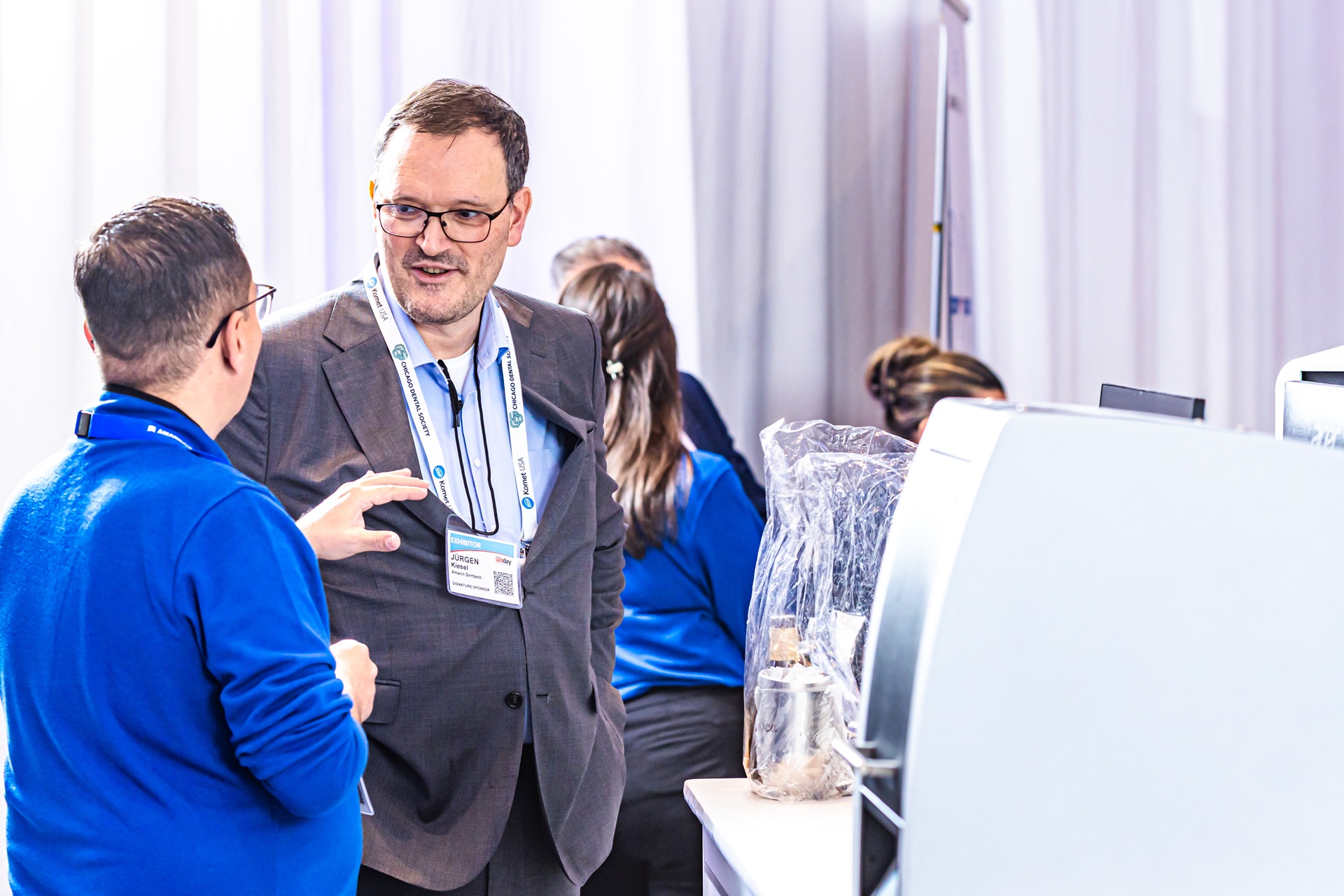
Jürgen Kiesel, CEO of Amann Girrbach (left), spoke with Lutz Hiller, member of the management board of OEMUS MEDIA, in Chicago earlier this year about the company’s current position and future direction. (All images: MattMcGrawPhoto)
Lutz Hiller, OEMUS MEDIA

Lutz Hiller, OEMUS MEDIA

Wed. 22. July 2026

save

Amann Girrbach develops CAD/CAM solutions for dental practices and laboratories. The company, which is headquartered in Mäder in Austria, has reshaped its portfolio, internal structures and distribution network in recent years. At the same time, rumours concerning financial difficulties and a potential sale have been circulating within the dental industry. In this interview, Amann Girrbach CEO Jürgen Kiesel responds to the speculation and discusses the company’s financial performance, workforce reductions, new distribution partnerships and broader strategic direction.

Mr Kiesel, you have led Amann Girrbach since 2023. There are rumours about the company ranging from a possible sale to financial difficulties and even insolvency. What is the reality?
From our perspective, the situation is very different. According to our internal figures, we achieved growth even during the economically challenging year of 2025. This continues the positive development seen in the previous year and demonstrates that the realignment initiated almost three years ago is delivering results. Alongside our established laboratory business, we intend to strengthen Amann Girrbach’s position as a provider of digital restorative solutions for dental practices. According to our internal analyses, we are among the fastest-growing companies in this field in the US. In the milling machine segment, we recorded year-on-year growth of 44%.

At the same time, we continue to deepen our expertise and expand our offering for dental laboratories. We are investing in the development of new products as well as in the refinement of established systems and materials. Against this background, I see no basis for the speculation currently circulating.

Jürgen Kiesel has served as CEO of Amann Girrbach since August 2023. Over the past two decades, he has held a range of leadership positions across the medical and dental industries.

Jürgen Kiesel has served as CEO of Amann Girrbach since August 2023. Over the past two decades, he has held a range of leadership positions across the medical and dental industries.

How do you account for the emergence of these rumours?
Amann Girrbach has evolved from a specialist focused primarily on dental laboratories into a more broadly positioned dental company. As a result, our competitors are taking greater notice of us than they did in the past. Competition for market share within the industry is also intense. I can only speculate about the source of the rumours and the motives behind them. To me, they demonstrate above all that the company now commands a considerably stronger market presence. We are no longer flying under the radar. Our relevance to both dental practices and laboratories has grown markedly in recent years. We remain firmly committed to our European sites and to manufacturing our milling machines in Austria.

What restructuring has already taken place, what further changes are planned and why is this realignment necessary?
The changes fall into three areas: products, strategic focus and new partnerships. We have traditionally been particularly strong in the premium segment. However, the market is increasingly demanding more accessible solutions for a broader range of users. We have therefore expanded our portfolio by introducing the Ceramill Motion Air milling machine and the Zolid Lunaris zirconia material. The Ceramill Motion Air features guided workflows that simplify operation. When used with a compatible high-speed sintering furnace, single crowns made from Zolid Lunaris can be sintered in just 15 minutes. This can support the efficient production of single-tooth restorations for same-day treatment.

“Our relevance to both dental practices and laboratories has grown markedly in recent years.”

At the same time, we are concentrating more closely on our core strengths and collaborating with strategic partners rather than seeking to offer everything ourselves. For example, we made a deliberate decision not to develop our own intra-oral scanner. This approach has helped us establish partnerships with internationally recognised dental distributors such as Patterson Dental and Henry Schein. Our open-system architecture also remains an important point of differentiation.

As part of this strategic focus, we reorganised operations across warehousing, shipping, product development and marketing. This involved workforce reductions, particularly in Germany. It was a difficult step but, from our perspective, a necessary one in order to reduce organisational complexity, make the company more agile and safeguard the long-term competitiveness of our European sites.

What does this realignment mean for the European market and Austria, Germany and Switzerland in particular?
As in the US, we intend to expand our presence in dental practices across Europe, particularly in Austria, Germany and Switzerland. Dentists who already work with our systems value above all the open workflows, ease of integration, reliability and quality. Our broader portfolio and stronger market presence will support this growth.

In Germany, we also continue to operate our own direct sales organisation, focusing particularly on dental laboratories. This keeps us directly accessible to our existing laboratory customers, while our wholesaler and distributor network gives customers additional ways to purchase our products.

What advantages do these changes offer your customers?
In the past, dental practices and laboratories generally had to order directly from us. Today, many of our products can also be purchased through wholesalers or distribution partners with whom customers already have an established relationship. This streamlines the procurement process. Zolid Lunaris and the Ceramill Motion Air also broaden the range of indications we can cover and the users we can serve.

Another advantage is our long-standing experience with zirconia. Our materials have been in clinical use for many years, and they are supported by clinical data and extensive practical experience. We are also continuing to expand our AG.Academy, which gives our customers access to continuing education both online and in person at our sites, helping them keep their professional knowledge and skills up to date.

You’ve personally been in the dental industry for over 20 years. How has the market changed since you entered the field?
The most significant change has undoubtedly been digitalisation. Amann Girrbach entered the CAD/CAM field at an early stage and is now making this experience available to a much broader range of users in both dental laboratories and practices. At the same time, aesthetic expectations have increased among patients and users alike. Materials such as Zolid Bion and Zolid Lunaris help us meet these changing expectations. Price pressure is also considerably greater than it was 20 years ago.

“The dental market is now governed by a much stronger commercial and operational focus.”

There is also a clear trend towards dental practice and laboratory chains. These organisations tend to have more sophisticated procurement and management structures. The dental market is now governed by a much stronger commercial and operational focus. As a manufacturer, we have had to adapt accordingly.

What measures have you taken over the past three years to support stable growth?
The most important measure has been to establish a clear strategic focus and improve efficiency across the organisation. This includes realistic budgeting and sound financing underpinned by reliable partners and long-term planning. We cannot spend more than we generate, and budgets cannot be based on assumptions alone.

At the same time, we are broadening our portfolio in order to respond to market needs and help shape future developments. We therefore continue to invest substantially in the development of new products.

Where do you currently see the greatest challenges, and how are you addressing them?
The greatest challenge is the global economic environment. We are seeing more cautious investment behaviour and a lower appetite for risk, including within the dental industry. This must be taken into account in both our product development and our commercial offering. The key is to develop solutions that deliver clear clinical, practical and economic value.

What products and services can your customers expect in the near future?
We are working on new products that we plan to present in the run-up to the 2027 International Dental Show. They are intended to address unmet needs in the market and respond to growing demand for aesthetic and implant dentistry solutions. The focus will be on solutions that can be implemented with minimal effort while offering a compelling balance between performance and cost. There is much more to come.

Editorial note:

This interview was first published on the ZWP online news platform. A translated, edited and abridged version is provided here with permission from OEMUS MEDIA.

Tags:
To post a reply please login or register
advertisement
advertisement