Cybersecurity expert Anne Genge maintains that the thoroughly interconnected nature of digital dentistry ecosystems presents a range of unique cybersecurity risks that practices should carefully address. (Image: greenbutterfly/Adobe Stock)
Within dentistry, what once involved a small number of independent systems now increasingly relies on continuous connectivity between devices, software platforms, vendors, cloud services, laboratories, insurers and increasingly, artificial intelligence (AI) services. In many practices, scanners transmit data to imaging software, imaging software syncs to the cloud, the cloud connects to third parties and remote service providers can log in at any time. From a clinical perspective, this progress is largely positive. Digital workflows improve efficiency, accuracy, collaboration and the patient experience. From a cybersecurity perspective, however, dentistry has shifted from a contained environment to a complex digital ecosystem, often without fully realising the implications. This article explains where cyber risks commonly arise within modern dental workflows and what clinicians need to consider before adopting digital technologies and what to monitor afterwards—in practical, non-technical terms. It aims to support safe, resilient and trustworthy digital dentistry.
When did dentistry become continuously connected?
The shift happened incrementally, one connected device, one cloud platform, one remote service agreement at a time. Many practices now rely on internet-connected scanners and imaging systems, cloud-based practice management and imaging software, remote vendor access for support and updates, digital communication with laboratories, insurers, and patients, and AI-enabled tools embedded within existing platforms. Each addition may seem manageable in isolation. Together, they fundamentally change where cyber risk enters the practice.
Cybersecurity is no longer limited to the front-desk computer or the server in the back room. It now affects whether clinicians can access imaging and records, whether appointments can proceed, whether billing and claims can be processed, whether patient data remains confidential, and whether patient trust is maintained. Cybersecurity has become an issue that affects operations, business continuity and, increasingly, patient care.
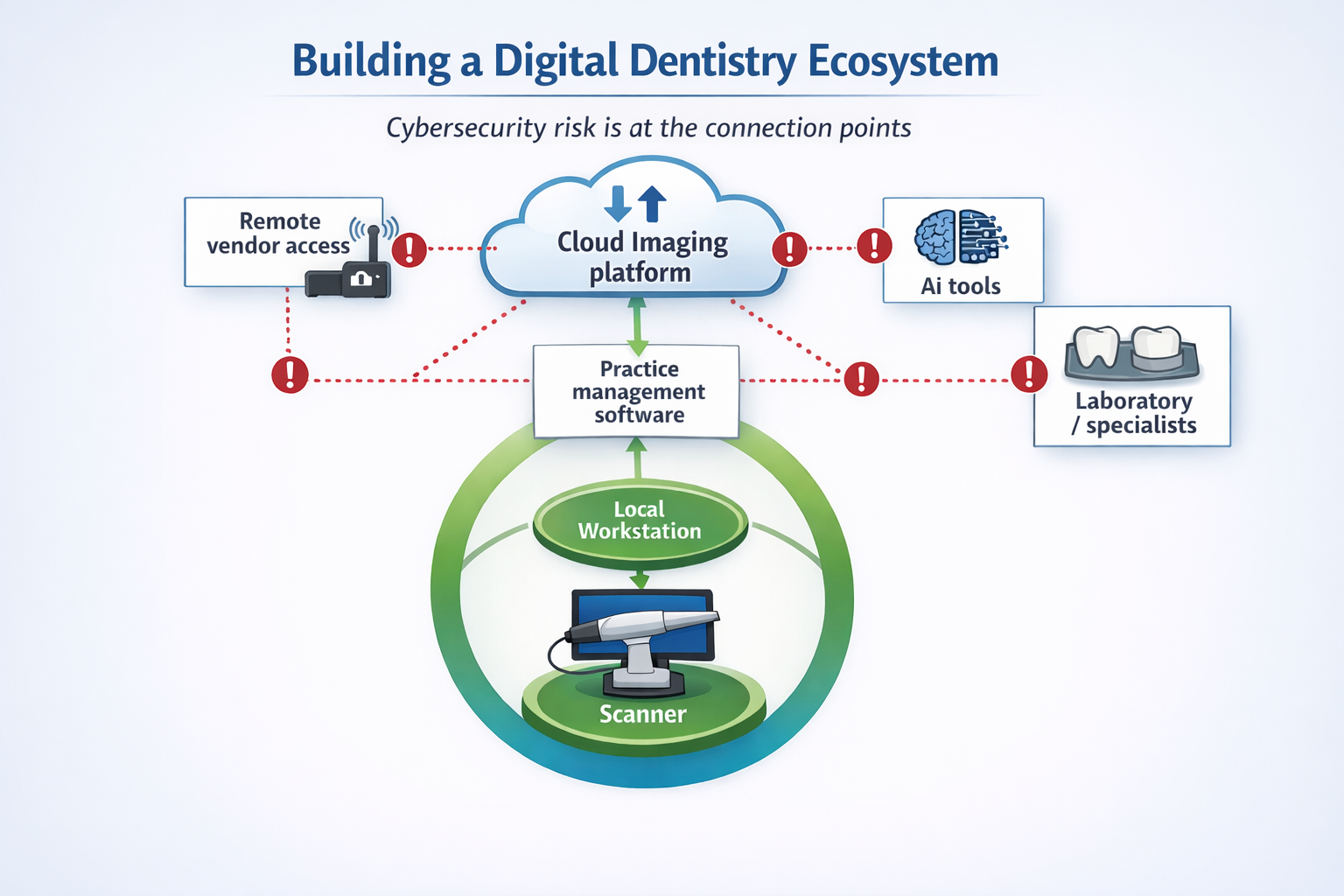
A schematic representation showing the various junctures at which cyber risk may enter a digital dental ecosystem. (Image: Anne Genge)
Are you buying a tool or building an ecosystem?
When adopting digital technology, many practices believe that they are purchasing a single tool. In reality, they are often building or expanding a digital ecosystem. A single scanner, for example, may involve the device itself, local software on a workstation, cloud storage or synchronisation, remote vendor access for maintenance, data sharing with laboratories or specialists, and integration with practice management systems.
Cyber risk rarely inhabits one system alone. It most often appears at connection points, where data moves between systems, where access is shared or where responsibility is unclear. The challenge for clinicians is not to master the underlying technical detail, but to make those connections, data flows and access points visible. What systems are connected? What data moves between them? Who can access that data inside and outside the practice? What happens if one part of the workflow fails? Management, vendors and IT providers may each see only part of the ecosystem. Without shared understanding and training, blind spots are inevitable. Cybersecurity in this context is less about firewalls and more about knowing what ecosystem has been put in place.
Where do cyber risks hide in digital workflows?
Cyber risks in dentistry are often invisible under normal operational conditions. They become visible only when something goes wrong. Networked devices and imaging systems are often treated as clinical equipment rather than computers. Yet many rely on operating systems and software that cannot be easily updated with security fixes, that run older software no longer supported by manufacturers or that ship with default security settings that are rarely reviewed.
Cloud services are widely misunderstood. While vendors may secure the infrastructure, practices remain responsible for user access management, password practices and authentication, access permissions and access monitoring—who accessed what and when. Cyber risk is then largely determined by the behaviour of the users.
“Cybersecurity has become an issue that affects operations, business continuity and, increasingly, patient care.”
Beyond what happens inside the practice, risk also enters through the people and organisations that connect to practice systems. Remote support and third-party integration are essential in modern dentistry, but they expand the practice’s digital boundary. Risk increases when vendors reuse the same support login credentials across multiple practices, remote access is enabled permanently rather than only when needed, practices cannot see when a vendor is logged in or responsibility for monitoring access is unclear.
The same applies to connected partners—laboratories, insurers, payment processors, marketing platforms and AI services. A practice does not need to be directly compromised to be affected; indirect exposure through a third party is now one of the most common paths for cyber incidents.
Why AI makes existing cyber risks more difficult to spot and control
AI does not introduce entirely new categories of cyber risk. Instead, it amplifies existing ones. AI is increasingly embedded within imaging software, scheduling and patient communication tools, documentation and workflow automation, and decision support and analytics platforms.
Because AI operates behind the scenes, clinicians may not realise how much data is being accessed or moved, whether data is used for training or improvement, how automated decisions are initiated, or how quickly missed or incorrect flags, information sent to the wrong place or unintended sharing of patient data, can scale. AI accelerates processes, increases data movement and reduces human manual checks for errors. From a cybersecurity perspective, this means less time to notice problems and greater impact when they occur. In this sense, AI acts as a risk accelerator, not as an isolated threat.
Before adoption: Are practices ready for digital technology risk?
Two principles that I think are especially important for practices to consider before adopting a digital technology are that, firstly, the digital tool should be selected according to the task to be achieved and, secondly, every technology decision requires evaluation of the associated privacy and cybersecurity implications. Digital technology adoption should begin with clarity. Rather than asking what technology should be purchased, the practice should consider what problem needs to be solved, what processes need to be improved or automated, and what data is involved in that task. Before introducing a new digital solution, practices need to understand what data will be accessed, created or transmitted, where that data will be transmitted and where it will be stored, who will have access, both inside and outside the practice, how updates and security changes will be handled, and what dependencies the practice will have on the technology—and what the impact of these will be if the system is unavailable. Cybersecurity should be part of adoption discussions from the outset, not an afterthought once systems are already in place.
What happens when a digital practice goes offline?
Cyber incidents are often framed as data breaches. In day-to-day practice, however, the most immediate impact is often operational disruption rather than data exposure or loss. When systems are unavailable, imaging and records may be inaccessible, appointments may need to be postponed or cancelled, scheduling and billing may halt, staff stress increases under uncertainty and patient confidence can be shaken. Cyber incidents caused by attacks, outages or technical failures quickly become continuity of care issues.
How can practices build cyber resilience without becoming cybersecurity experts?
Cyber resilience does not require clinicians to become cybersecurity specialists. It requires awareness, preparation and informed decision-making. Key elements of resilience include regular training for the entire dental team, clear understanding of digital dependencies, defined roles for decision-making during disruption, documented procedures for downtime and recovery, and regular cybersecurity reviews, rather than one-time checklists.
“Connectivity, automation and AI will continue to reshape clinical and operational workflows.”
The dental team plays a central role. Many cyber incidents begin with everyday actions such as clicking links or responding to emails that appear routine. Training empowers teams to recognise risk without fear or blame.
The bottom line: Can digital dentistry be safe and connected?
Connectivity, automation and AI will continue to reshape clinical and operational workflows. Cybersecurity is now part of patient safety, professional responsibility, practice resilience and long-term trust. When addressed early and openly, cybersecurity supports innovation rather than hindering it. The most resilient practices are those that understand the risks, dependencies and responsibilities that come with being connected, but those that understand the risks, dependencies and responsibilities that come with being connected.
Practice takeaway
When adopting digital dental technology, clinicians are rarely purchasing a stand-alone device. They are implementing a connected ecosystem that includes software platforms, cloud services, remote access and third-party integration. Cyber risk rarely exists in any one system. It most often appears at the connection points, where data moves between systems, access is shared or responsibility becomes unclear. Thoughtful digital technology adoption begins with understanding how a new tool connects to existing workflows, what data it accesses, who can access it and what happens if that connection is disrupted.
A practical checklist: Questions to ask before and after adopting digital dental technology
Before adoption
What specific task or workflow problem are we trying to solve?
What patient or practice data will this system access, create or transmit?
Where will that data be transmitted, and where will it be stored?
Who will have access to the system, both inside and outside the practice?
Does this system rely on cloud services, remote access or third-party integration?
What other systems will it connect to or depend on?
Who will be responsible for security updates, access monitoring and access management?
After adoption
Do we know which systems are connected and how they interact?
Can we see when external vendors or service providers are accessing our systems?
Have team members been trained on how this technology changes daily workflows?
Do we have a plan if this system becomes unavailable, even temporarily?
Have we reviewed whether vendor access and third-party integration are still necessary?
Dentists dedicate immense effort to building thriving practices, adopting advanced technologies and improving workflows, towards enhancing patient care. ...
It is common to think of cyber-attacks as isolated incidents—one office, one victim, one mistake—but in reality, practices are connected. The systems ...
The rapid rise of digital dentistry has given dentists worldwide many benefits, but it has also increased risks. Dental teams must learn to leverage these ...
In Part 2 of this series, we talked about common cyber threats affecting dental practices. Imagine coming into the office on Monday morning, only to find ...
The Class II restoration remains one of the most common—and technically demanding—procedures in dentistry. Every day, clinicians must deliver durable, ...
HELSINKI, Finland: Three-dimensional dental imaging technology and software continue to make great strides when it comes to improving image quality. ...
Kraków, Poland: Seamless and streamlined cooperation between dentists and dental technicians is a recipe for success. In Japanese, “kizuna” describes a...
LONDON, England: In the Global North, HIV/Aids is often seen as a historic problem; however, as UNAIDS Executive Director Winnie Byanyima stressed in a new ...
ISTANBUL, Turkey: From 15 to 18 April, IDEX Istanbul 2026 will convene the global dental industry at the Istanbul Expo Center. One of the world’s leading...
At the 2025 International Dental Show (IDS), Dentsply Sirona has reinforced its commitment to innovation and connected dentistry. In this interview, ...
Education
Live webinar Wed. 25 March 2026 12:00 pm EST (New York)



 Brazil / Brasil
 Canada / Canada
 Latin America / Latinoamérica
 USA / USA
 Austria / Österreich
 Bosnia and Herzegovina / Босна и Херцеговина
 Bulgaria / България
 Croatia / Hrvatska
 Czech Republic & Slovakia / Česká republika & Slovensko
 France / France
 Germany / Deutschland
 Greece / ΕΛΛΑΔΑ
 Hungary / Hungary
 Italy / Italia
 Netherlands / Nederland
 Nordic / Nordic
 Poland / Polska
 Portugal / Portugal
 Romania & Moldova / România & Moldova
 Slovenia / Slovenija
 Serbia & Montenegro / Србија и Црна Гора
 Spain / España
 Switzerland / Schweiz
 Turkey / Türkiye
 UK & Ireland / UK & Ireland
 China / 中国
 India / भारत गणराज्य
 Pakistan / Pākistān
 Vietnam / Việt Nam
 ASEAN / ASEAN
 Israel / מְדִינַת יִשְׂרָאֵל
 Algeria, Morocco & Tunisia / الجزائر والمغرب وتونس
 Middle East / Middle East

 Prof. Sérgio André QuaresmaRegister now1CELive webinar
 Dr. John Flucke DDSRegister now1CELive webinar
 Dr. João AbreuLive webinar

 Dr. Laurence Adriaens, Dr. Ghida Lawand BDS, MScRegister now1CE









To post a reply please login or register