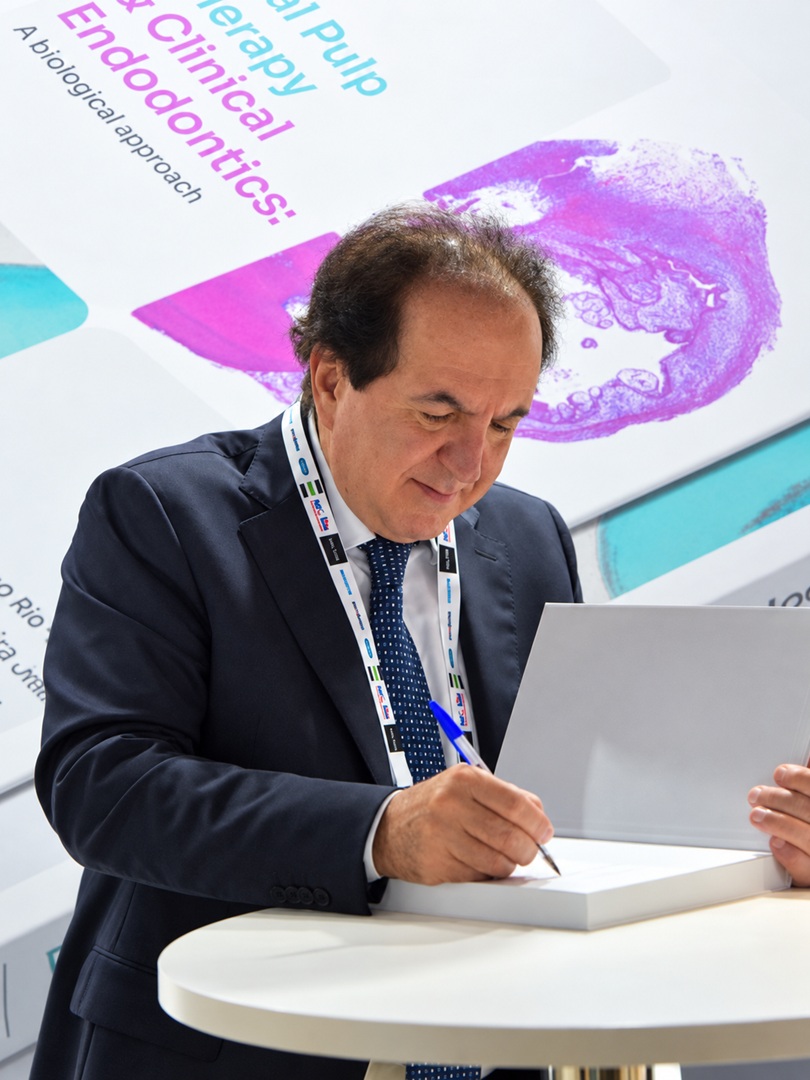
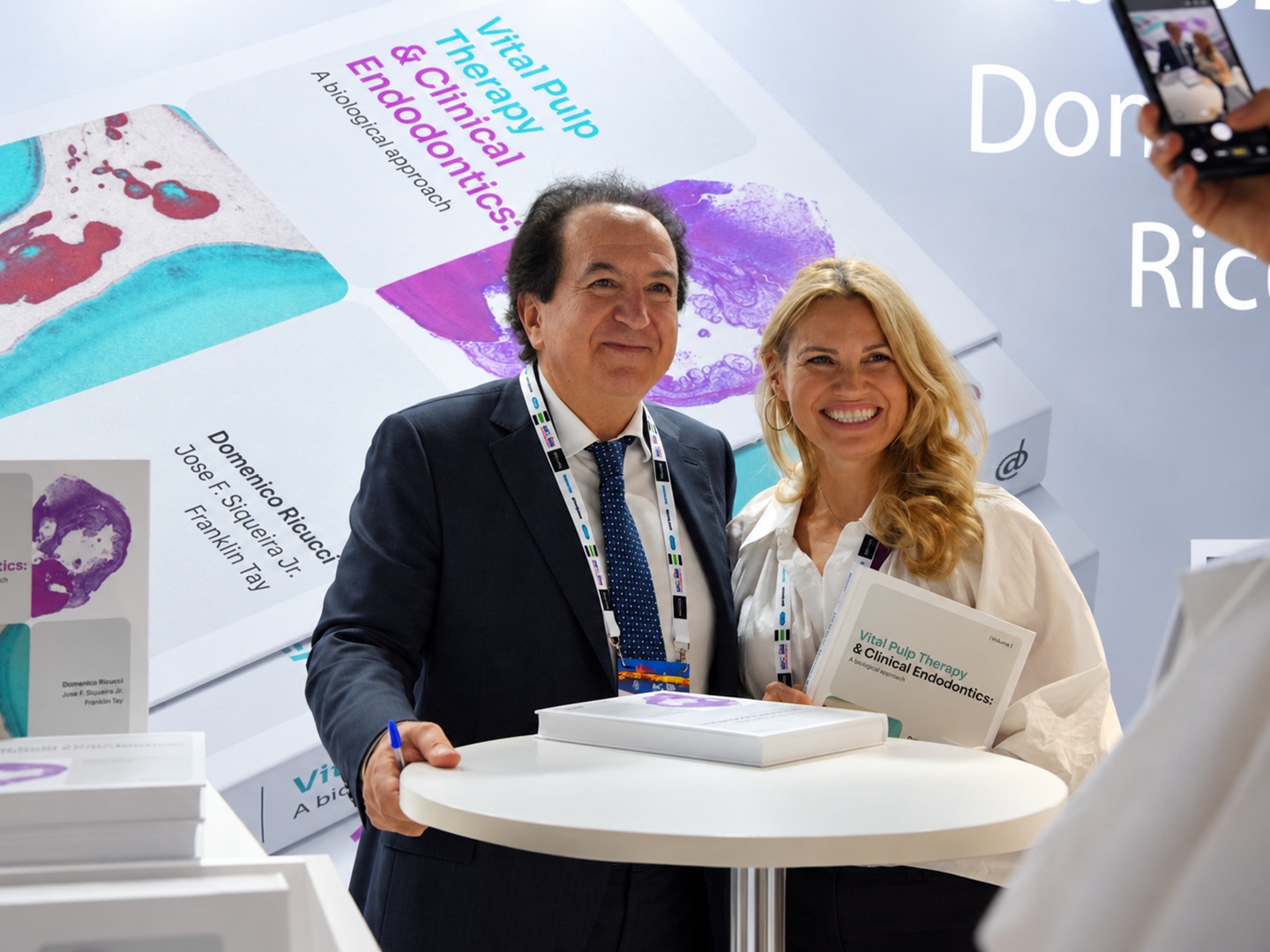
At the 2026 FDI World Dental Congress, Dr Domenico Ricucci signed copies of his new book for congress participants. (All images: Dental Tribune International)
Integrating biological knowledge into clinical decision-making is central to the annual Endo Sapiens meeting, which will take place in Berlin in Germany from 8 to 10 October. Led by the established endodontist and researcher Dr Domenico Ricucci, the meeting will bring together international speakers for a scientific programme focused on biologically driven endodontics. The event coincides with the publication of Dr Ricucci’s latest textbook. At the recent FDI World Dental Congress, Dental Tribune International spoke with Dr Ricucci about the philosophy behind Endo Sapiens, the role of biology and histology in clinical endodontics, and his new book.
Dr Ricucci, Endo Sapiens is being held for the fifth time. What was your original vision for the event, and how has it developed since then? Endo Sapiens was born from an idea by Andrey Boldov, founder and CEO of the dental education company Dentoki. He came to me with the idea of organising an event that would bring together clinicians and researchers with expertise relevant to endodontics, especially in biology, while keeping the programme independent of commercial influence. That independence was very important to us because we wanted the scientific content to remain free from commercial pressure.
Dr Domenico Ricucci founded the Endo Sapiens project in 2021. Its first annual international endodontic forum was held in Rome in Italy in 2022.
The adventure began in Rome in Italy in 2022, and the first meeting was a success, attracting participants from many parts of the world. After that first experience, we wanted to continue. The second edition was held in Barcelona in Spain the following year and the third in Paris in France. In Paris, we had almost 600 participants from 61 countries, including Australia and New Zealand. That success encouraged us to continue because our participants want clear, independent scientific information, and that is the approach that we intend to maintain. Dental Tribune International has been a partner from the beginning, and we are very grateful that this cooperation has continued as the meeting has developed.
The guiding principle behind Endo Sapiens is that biological understanding should inform clinical practice. Where do you see the greatest gap between current biological and histological evidence and endodontic practice?
Yes, this is central to the Endo Sapiens approach. We try to connect clinical practice more closely with biological knowledge. This emphasis arose from the observation that most clinicians, regardless of their level of experience, focus on techniques, materials and procedures. These are, of course, very important. A dentist cannot be successful without good clinical skills. However, we encourage clinicians to look more deeply at the biological basis of treatment.
We therefore place much greater emphasis first on normal tissue physiology and then on the pathological processes affecting the tissue. In endodontics in particular, we focus on the disease process associated with caries. We seek to emphasise the underlying biological processes: how the pulp tissue responds to the microbial challenge associated with progressing caries and how inflammation develops.
“We encourage clinicians to look more deeply at the biological basis of treatment.”
When treatment is performed at a later stage, we try to reach agreement on procedures such as direct pulp capping, partial pulpotomy and complete pulpotomy, which can allow us to maintain the vitality of at least part of the pulp. In the past, teeth diagnosed with irreversible pulpitis arising from deep caries were generally treated with root canal treatment. Today, we seek to practise minimally invasive dentistry: we try to preserve as much healthy tissue as possible.
This connection between biology, histology and clinical practice is also reflected in the Endo Sapiens programme. During the meeting in October, you will be leading a masterclass on vital pulp therapy. What will participants learn from the session?
During the meeting, there will be several masterclasses. Mine will focus on vital pulp therapy. Dr Gilberto Debelian will demonstrate clinical procedures in non-surgical endodontic retreatment, Dr Allen Ali Nasseh will present a microsurgical approach to molar apicectomy.
The new book comprises two volumes and 16 chapters covering the biological basis and clinical practice of endodontics, including vital pulp therapy. It has been published in English, Spanish and Russian.
Vital pulp therapy is relatively new as a practical teaching topic because we face a challenge in providing hands-on training: the clinical environment of a vital tooth, including bleeding and pulp tissue, cannot easily be reproduced in a model. In vital pulp therapy, we are not treating hard, mineralised tissue alone; we also need to account for the pulp. We have therefore worked with companies to develop models that simulate pulp tissue and bleeding. These offer, of course, only an approximation of the clinical situation, but I think we have succeeded.
After discussing the biological basis, pathology and diagnostic aspects, I will demonstrate direct pulp capping, partial pulpotomy and complete pulpotomy using these models and contemporary bioceramic materials. This will allow participants to observe each step of the procedures.
Your new book, Vital Pulp Therapy and Clinical Endodontics: A Biological Approach, is also being presented at the FDI congress. How does the book build on these themes? Although “vital pulp therapy” appears in the title of the book, it is really a textbook of endodontics that places particular emphasis on vital pulp therapy. The first chapter deals with the laboratory procedures used to process teeth and periradicular tissue for histological examination, which is an important part of the book. We focus on histology because it allows us to show tissue morphology at the cellular level. The first chapter therefore deals with the techniques used to produce histological sections. The following chapters move from the biology of normal tissue to the tissue response to caries and then to the treatment of deep caries, including the procedures used in vital pulp therapy, presented step by step.
Editorial note:
More information about the Endo Sapiens event can be found at endosapiens.com/2026.
Dr Dympna Kavanagh is chief dental officer in Ireland’s Department of Health and chair of the Platform for Better Oral Health in Europe. A specialist in ...
BRUSSELS, Belgium: Besides crippling health effects, smoking can cause serious damage to oral health, putting smokers at an increased risk of periodontal ...
DUNDEE, Scotland: Management of irreversible pulpitis in permanent teeth is undergoing a gradual but meaningful shift. Advances in diagnostic understanding ...
MELVILLE, N.Y., US: Henry Schein has announced the appointment of Frederick M. Lowery as CEO, effective from 2 March. Lowery will also join the company’s...
DUBAI, UAE: New York University (NYU) in the US has appointed Dr Abdulsalam al-Madani as a professor, making him the first Emirati to hold such an academic...
DALLAS, US: As artificial intelligence (AI) tools are increasingly explored in dental education and clinical learning, questions remain about how reliably ...
BOSTON, US: Dental artificial intelligence (AI) startup LightSpun has secured US$13 million (€11 million*) in new funding, positioning the company at ...
SCHAAN, Liechtenstein: For the first time, Ivoclar Vivadent will hold its International Expert Symposium (IES) as an online event. It will take place from ...
AMSTERDAM, Netherlands: The latest findings and the newest solutions for hard- and soft-tissue health and regeneration are hot topics. Attendees can join ...
Education
Live webinar Thu. 15 October 2026 10:00 am EST (New York)
GUANGZHOU, China: Artificial intelligence (AI) has already demonstrated substantial utility in dentistry. Researchers are now exploring whether it could ...
WASHINGTON, US: A new report by the American Dental Education Association has highlighted encouraging trends in US predoctoral dental education that could ...
LEEDS, England: Overseas-qualified dentists make up an increasing proportion of those joining the UK workforce. Mentoring may help them adapt to a different...



 Brazil / Brasil
 Canada / Canada
 Latin America / Latinoamérica
 USA / USA
 Austria / Österreich
 Bosnia and Herzegovina / Босна и Херцеговина
 Bulgaria / България
 Croatia / Hrvatska
 Czech Republic & Slovakia / Česká republika & Slovensko
 France / France
 Germany / Deutschland
 Greece / ΕΛΛΑΔΑ
 Hungary / Hungary
 Italy / Italia
 Netherlands / Nederland
 Nordic / Nordic
 Poland / Polska
 Portugal / Portugal
 Romania & Moldova / România & Moldova
 Slovenia / Slovenija
 Serbia & Montenegro / Србија и Црна Гора
 Spain / España
 Switzerland / Schweiz
 Turkey / Türkiye
 UK & Ireland / UK & Ireland
 China / 中国
 India / भारत गणराज्य
 Pakistan / Pākistān
 Vietnam / Việt Nam
 ASEAN / ASEAN
 Israel / מְדִינַת יִשְׂרָאֵל
 Algeria, Morocco & Tunisia / الجزائر والمغرب وتونس
 Middle East / Middle East

 Dr. Sinan GhishanRegister now1CELive webinar
 Dr. Sonia PresenciaLive webinar
 Dr. John Tsourounakis DDS, Cert. Perio, MS, FRCD(C)Register now1CELive webinar

 Dr. Varkha Rattu, Cat EdneyRegister now1CE















To post a reply please login or register