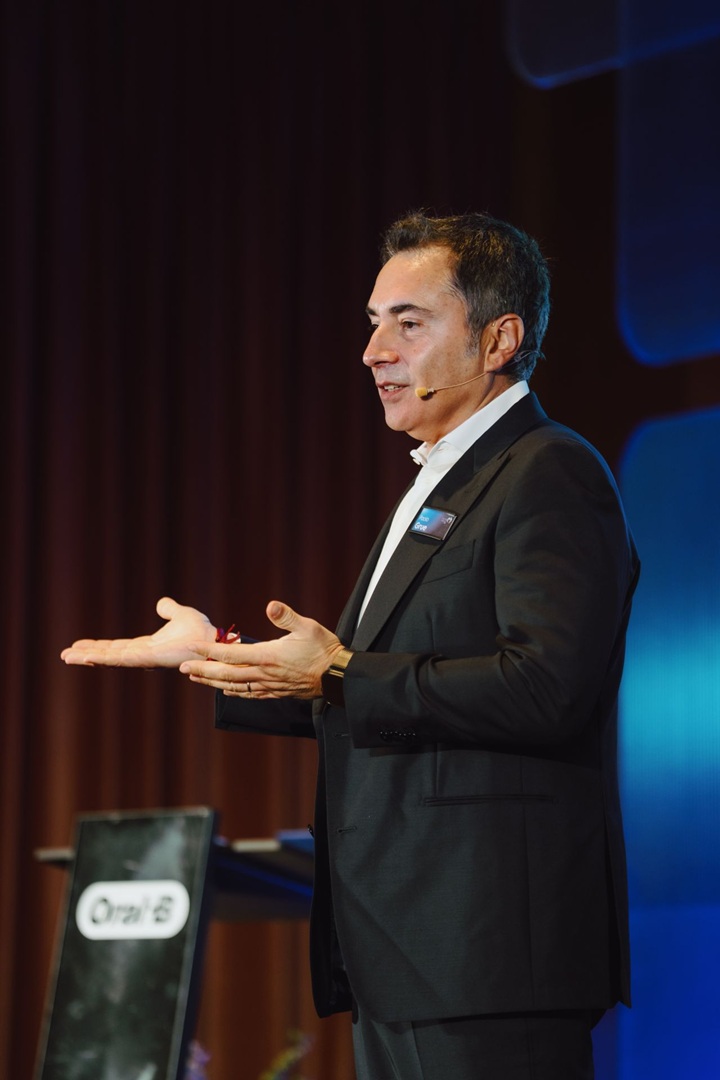
Paolo Grue is the senior vice-president of oral care in Europe at Procter & Gamble. He spoke at the Project Steady launch in Barcelona in Spain in May. (All images: PG ONE)
Everyday dental care can be difficult for many people with disabilities. To make oral care more inclusive, accessible and positive, Oral-B is collaborating with the International Association for Disability and Oral Health through the Big Rethink initiative. This year, they have launched Project Steady, a six-month, multi-country study gathering feedback from people with disabilities, their carers and their dental professionals in Europe. In this interview with Dental Tribune International, Paolo Grue, head of Procter & Gamble’s European oral care business, discusses what the Big Rethink has learned over the past four years and how the ongoing project aims to improve oral health.
Mr Grue, could you tell us a little about your professional background and how you became involved with Oral-B’s dental inclusivity project?
I’ve been with Procter & Gamble for 25 years, which has given me the opportunity to work across a range of countries and product categories. Most recently, I was managing director for Italy. Earlier this year, I began a new role leading the company’s European oral care business. It has been quite a shift for me, and one I’ve been really excited about.
“By gathering feedback across Europe, we aim to identify practical ways to support daily oral care and remove the everyday barriers that disrupt routines.”
What makes it especially meaningful is the level of impact we can have. In oral care, we’re not just building brands; we’re influencing one of the most ingrained daily habits. Brushing your teeth is something you learn as a child and carry with you throughout your life, so being able to improve that behaviour at scale is both tangible and rewarding. At the same time, it is clear that not everyone has the same ability or opportunity to perform toothbrushing easily.
My role connects naturally with the team’s ongoing work in advancing oral care, particularly the Big Rethink. The team has already made fantastic progress over the last four years in making oral care more inclusive. What really excites me is the opportunity to build on that momentum by designing products and experiences that work for people with both visible and non-visible disabilities. As we enter the next phase of the Big Rethink, we have the opportunity to go even further to help ensure that oral health is accessible to all.
The Big Rethink has been running for four years. What has Oral-B learned during this time from people with disabilities, as well as their caregivers and dental professionals, and how have these lessons shaped the direction of the project? One of the clearest insights has been the scale of the challenge: this is not a marginal issue. From our surveys, we’ve learned that four in ten Europeans identify as having a disability. We’ve also learned that daily oral care experiences differ dramatically. Our research shows that over half of people with physical disabilities and nearly two-thirds of people with cognitive disabilities struggle with oral care, compared with one-third of non-disabled people. This disparity underscores the need for oral health systems, tools and services to better reflect real-life conditions.
Paolo Grue stated that Project Steady builds on the Big Rethink by using insights from people with disabilities to create more inclusive oral health solutions.
Most importantly, we’ve learned that practical and often seemingly minor barriers—including issues with toothbrush usability, grip and stability—can have a disproportionate impact on oral care routines. Anxiety surrounding oral care can also negatively affect daily routines. Addressing these factors has fundamentally shaped the evolution of the project and has prompted the Project Steady research initiative.
What questions do you hope the study will answer for oral care professionals, and how could the findings translate into daily clinical practice?
The aim of the study is to gain a more complete understanding of everyday oral care at scale. The key question is: what supports or hinders effective daily oral care routines at home?
By gathering feedback across Europe, we aim to identify practical ways to support daily oral care and remove the everyday barriers that disrupt routines. The research builds directly on findings from a pilot phase conducted earlier this year among patients with limited dexterity. In that pilot, nine in ten participants who used a new adaptive accessory alongside Oral-B’s iO2 electric toothbrush for one month were able to reduce areas of high plaque accumulation, and two in five showed improved gingival health.
We were also able to gather important feedback on daily use of the accessory and its benefits. Participants said that the toothbrush was easier to hold and control, offered a more comfortable brushing experience and helped them to clean difficult-to-reach tooth surfaces.
The insights that we are gaining will support dental professionals in providing practical guidance to patients and will reinforce the importance of usable oral care tools in helping patients maintain their oral health in the long term. Ultimately, we aim to help improve clinical care and oral health outcomes through solutions that are grounded in lived experience.
Earlier phases of the Big Rethink highlighted barriers such as dental anxiety, practice accessibility, and challenges with toothbrushing technique and motivation. How can dental teams better identify barriers during consultations, particularly when a patient’s disability is not visible?
The key is recognising that barriers are often hidden. Non-visible disabilities, fatigue, anxiety and cognitive challenges may not be immediately apparent, but can significantly affect oral care routines.
“The insights that we are gaining will support dental professionals in providing practical guidance to patients.”
Dental teams play an important role by creating space for open conversations about patients’ oral care routines and experiences. The evidence shows that struggles with consistency or technique are often not about motivation but about practicality and effort. When consultations focus on understanding lived experience, clinicians are better able to identify barriers and adapt care accordingly.
The Disability Champions initiative encourages practices to appoint a team member to lead the practice on accessibility and inclusion. What does the role of a Disability Champion involve in practical terms, and what are the first steps that practices can take to become more disability-positive—that is, responsive to the needs of patients with disabilities? Disability Champions help ensure that accessibility and inclusion are considered consistently throughout the patient journey, including communication, appointment scheduling, administrative procedures and the experience within the practice. The first steps often involve creating greater awareness and providing education within dental teams. As part of our partnership with the International Association for Disability and Oral Health, we have collaborated on educational resources designed to improve dental teams’ support for patients with disabilities and their caregivers. Becoming more disability-positive is an ongoing commitment that requires practices to review their processes, learn from patients and caregivers, and embed inclusive practices over time.
What needs to change in the areas of education, product design, practice workflows and advocacy to raise the standard of oral care for people with disabilities?
Raising the standard of care requires coordinated action. Education needs to reflect the realities of everyday life for patients with disabilities. Product design must prioritise usability and lived experience from the outset. Practice workflows should be flexible enough to meet diverse needs. Advocacy must also keep accessibility and inclusion firmly on the agenda.
The Big Rethink 2026 takes a decisive step by pairing large-scale research with inclusive design and professional education; however, no single organisation can do this alone. Progress depends on long-term collaboration between clinicians, the dental industry, educators, disability organisations and policymakers. Only in this way can we make real and lasting progress. When inclusion leads, better oral and overall health will follow.
BARCELONA, Spain: Oral-B has announced a large Europe-wide study on the oral care experiences of people with disabilities—Project Steady. The research is ...
A Europe-wide study conducted in 2021 and 2022 and commissioned by Oral-B, a brand of Procter & Gamble (P&G), has shown that 34% of people in Europe...
Education
Live webinar Thu. 15 October 2026 10:00 am EST (New York)



 Brazil / Brasil
 Canada / Canada
 Latin America / Latinoamérica
 USA / USA
 Austria / Österreich
 Bosnia and Herzegovina / Босна и Херцеговина
 Bulgaria / България
 Croatia / Hrvatska
 Czech Republic & Slovakia / Česká republika & Slovensko
 France / France
 Germany / Deutschland
 Greece / ΕΛΛΑΔΑ
 Hungary / Hungary
 Italy / Italia
 Netherlands / Nederland
 Nordic / Nordic
 Poland / Polska
 Portugal / Portugal
 Romania & Moldova / România & Moldova
 Slovenia / Slovenija
 Serbia & Montenegro / Србија и Црна Гора
 Spain / España
 Switzerland / Schweiz
 Turkey / Türkiye
 UK & Ireland / UK & Ireland
 China / 中国
 India / भारत गणराज्य
 Pakistan / Pākistān
 Vietnam / Việt Nam
 ASEAN / ASEAN
 Israel / מְדִינַת יִשְׂרָאֵל
 Algeria, Morocco & Tunisia / الجزائر والمغرب وتونس
 Middle East / Middle East

 Dr. Sinan GhishanRegister now1CELive webinar
 Dr. Sonia PresenciaLive webinar
 Dr. John Tsourounakis DDS, Cert. Perio, MS, FRCD(C)Register now1CELive webinar

 Dr. Varkha Rattu, Cat EdneyRegister now1CE








To post a reply please login or register