Osstem Implant and global experts have published a consensus paper proposing clinical guidance on implant prosthetics and supracrestal complex management. (Image: greenbutterfly/Adobe Stock)
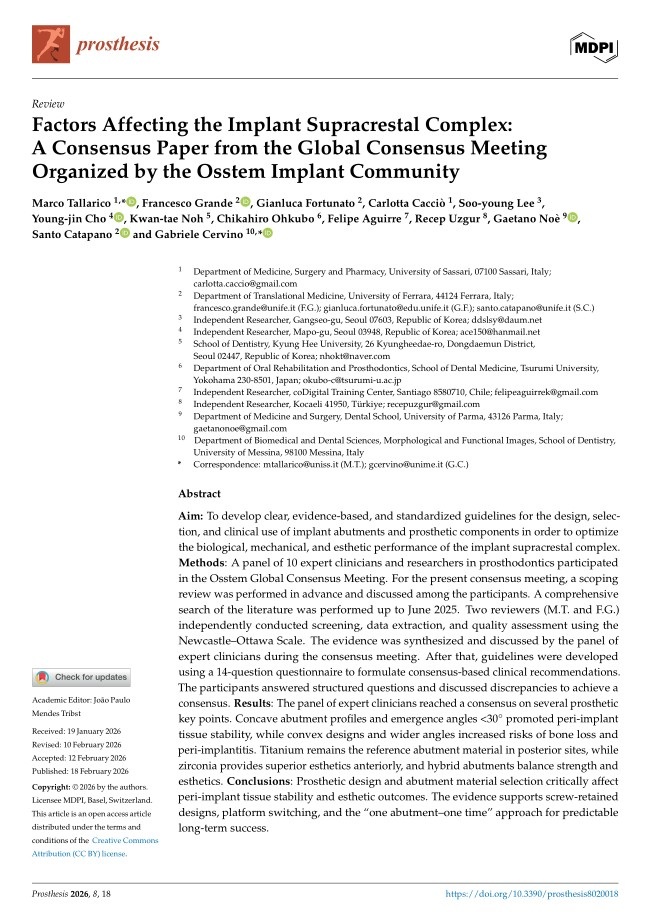
SEOUL, South Korea: Osstem Implant has published a consensus paper after convening internationally recognised experts to discuss clinical factors affecting the implant supracrestal complex. The recommendations aim to provide practical guidance for clinicians to optimise long-term implant outcomes.
The paper was developed through the Osstem Implant Global Consensus Meeting, a scientific initiative organised by the company that brings together international experts—including directors of the Osstem Master Course programme—to discuss clinically relevant topics and develop practical guidance for clinicians. The meeting has been held regularly since 2023 in both online and in-person formats.
Participants of the Osstem Implant Global Consensus Meeting. From left: Dr Soo-young Lee, Prof. Gaetano Noè, Dr Recep Uzgur, Prof. Chikahiro Ohkubo, Dr Felipe Aguirre, Dr Marco Tallarico, Dr Cho In-ho, Dr Eugene Kim, Dr Young-jin Cho, Prof. Kwan-tae Noh and Prof. Kim Jong-eun. (Image: Osstem Implant)
The latest meeting focused on factors affecting the implant supracrestal complex. Eight international experts participated in the discussion, with the meeting chaired by Dr Marco Tallarico. In preparation for the discussion, the experts conducted a scoping review of the scientific literature to assess current evidence on prosthetic and clinical factors that may influence the implant supracrestal complex and peri-implant tissue stability. During the meeting, the panel discussed the definition and clinical significance of the supracrestal complex, prosthetic design elements such as emergence profile and emergence angle, abutment material selection, and implant placement depth and positioning.
The consensus paper proposes 14 evidence-based clinical recommendations on prosthetic design, abutment materials and implant placement to support long-term implant outcomes. (Image: Osstem Implant)
The discussion resulted in 14 consensus statements presented as practical clinical guidance. The recommendations address topics including the definition of peri-implant tissue attachment, the advantages of screw-retained prostheses, clinical application of platform switching, optimisation of abutment design—including concave profiles and emergence angles—guidelines for implant placement depth and positioning, recommendations for abutment material selection, the one abutment–one time protocol, and the application of digital technologies and artificial intelligence-assisted approaches.
Dr Cho In-ho, director of Osstem’s dental research institute, commented: “Prosthetic design and abutment material selection are critical factors influencing peri-implant tissue stability and aesthetic outcomes in implant dentistry. This consensus was developed to provide clear, evidence-based clinical guidelines for the design, selection and clinical use of implant abutments and prosthetic components to optimise the biological, mechanical and aesthetic performance of the implant supracrestal complex.”
He added: “Osstem Implant will continue to organise consensus meetings and support clinical research activities to propose practical guidelines that contribute to the advancement of implant dentistry worldwide.”
SEOUL, South Korea: Osstem Implant has announced plans to conduct strategic consultations with dealers, manufacturers and distributors looking to expand ...
SEOUL, South Korea: Osstem Implant, one of the world’s leading dental implant manufacturers, has published a new consensus statement outlining prosthetic ...
SEOUL, South Korea: Osstem Implant appointed Hae-Sung Kim as new CEO at its extraordinary general shareholders’ meeting in August. Kim joined the company ...
SEOUL, South Korea: Osstem Implant has expanded its global presence from an initial network of 12 overseas subsidiaries established in 2006 to 33 entities ...
SEOUL, South Korea: On a yearly basis, Osstem Implant’s subsidiaries organise the Osstem Meetings, which are country-specific events, in their respective ...
SEOUL, South Korea: Osstem Implant has announced that cumulative global sales of its K3 and K5 dental unit chairs have exceeded 60,000 units. The milestone ...
VIENNA, Austria: For the first time, Osstem Implant, a global leader in dental implant technology and comprehensive dental solutions, will be participating ...
MONACO: Osstem Implant has announced its participation in the 32nd Annual Scientific Meeting of the European Association for Osseointegration (EAO 2025), ...
SEOUL, South Korea: The Osstem Master Course is a comprehensive, integrated clinical programme comprising 24 sessions. Moving beyond one-off courses, it ...
PRAGUE, Czech Republic: In collaboration with OIC Europe, Osstem Europe has opened registration for this year’s Osstem Europe Meeting, which will take ...
SEOUL, South Korea: Osstem Implant has outlined the scale of its global manufacturing network and quality management system as part of its strategy to ...



 Brazil / Brasil
 Canada / Canada
 Latin America / Latinoamérica
 USA / USA
 Austria / Österreich
 Bosnia and Herzegovina / Босна и Херцеговина
 Bulgaria / България
 Croatia / Hrvatska
 Czech Republic & Slovakia / Česká republika & Slovensko
 France / France
 Germany / Deutschland
 Greece / ΕΛΛΑΔΑ
 Hungary / Hungary
 Italy / Italia
 Netherlands / Nederland
 Nordic / Nordic
 Poland / Polska
 Portugal / Portugal
 Romania & Moldova / România & Moldova
 Slovenia / Slovenija
 Serbia & Montenegro / Србија и Црна Гора
 Spain / España
 Switzerland / Schweiz
 Turkey / Türkiye
 UK & Ireland / UK & Ireland
 China / 中国
 India / भारत गणराज्य
 Pakistan / Pākistān
 Vietnam / Việt Nam
 ASEAN / ASEAN
 Israel / מְדִינַת יִשְׂרָאֵל
 Algeria, Morocco & Tunisia / الجزائر والمغرب وتونس
 Middle East / Middle East

 Dr. Shizuma ShibataLive webinar
 Dr. Matthias RzeznikRegister now1.5CELive webinar
 Dr. Mona PatelRegister now1CELive webinar

 Prof. Moritz Kebschull, Cat EdneyRegister now1CE









To post a reply please login or register