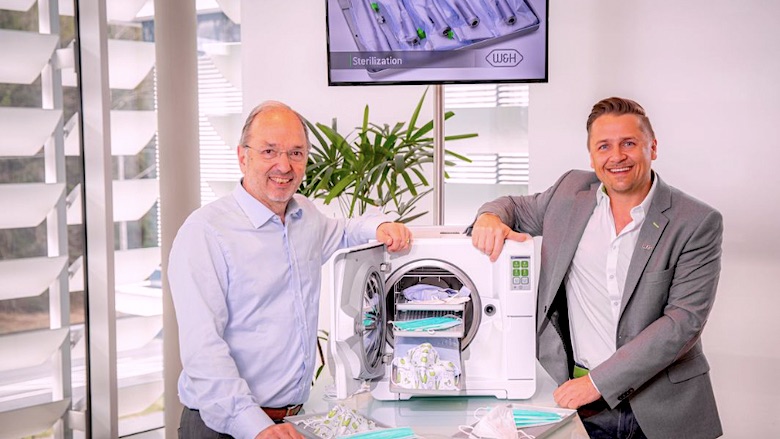
W&H president Peter Malata (left) and service manager Josef Erbschwendtner trying sterilized face masks in one of the company’s autoclaves. (Photo: W&H Dentalwerk)
As a pioneer and market leader in sterilization, Austria-based company W&H is renowned for developing high-quality sterilization devices for the dental practice. Dental Tribune Latin America talked to W&H president and CEO, Peter Malata, to find out what are the appropriate sterilization levels now needed in the dental office.
How is W&H dealing with the SARS-CoV-2 pandemic? We have developed two distinct approaches. On one hand, we are supporting the healthcare systems locally. This ranges from donations of sterilizers in especially affected regions to special rental offers in other areas.
At the same time, our W&H-Sterilization manufacturing plant, located just outside of Bergamo, Italy, is in one of the most affected regions in Europe. We of course have ensured that all our employees are working in a safe environment, and that all people who can work from home are working from home. For the rest of our workers, we have ensured the safest working conditions. Moreover, I am very happy to say that no employees of W&H-Sterilization have been affected by coronavirus infections.
Implementing adequate infection control procedures ensures the safest level of working conditions in the dental practice, says W&H CEO Peter Malata (left). (Photo: W&H Dentalwerk)
What equipment do you manufacture at the W&H facility in Italy? The entire line of W&H sterilization equipment is developed and manufactured at W&H-Sterilization, in the Lombardy region.
Where is it located? W&H-Sterilization is based just outside Bergamo, which is at the center of the pandemic in Italy, and our employees have managed the situation in an exemplary manner.
Is the W&H manufacturing facility in Italy in operation? Yes. We are very happy to say that due to the careful attention to the hygienic rules we applied and the efforts of our Italian team, W&H-Sterilization has been operating continuously, and we have been able to serve the high demand for sterilization equipment from all our customers.
What biosecurity measures have been implemented there? At W&H-Sterilization, everybody followed the recommendation of our specialists. We rigorously applied all rules suggested by experts: wearing protection masks, maintaining enough working distance, and reducing the number of people working at the same time. In addition, of course, we have encouraged everyone to wash hands, sneeze into the elbow. All employees who could work from home are doing so. By implementing all these measures, we have managed to keep W&H-Sterilization operating.
“All W&H sterilizers kill the coronavirus”
Has the pandemic changed biosecurity needs in the dental office? Definitely. Even though dentists were already before the pandemic the medical profession that used more protective equipment than any other medical profession. Dental practices are now putting additional measures in place, such as having less patients in their waiting rooms, complete room disinfection after each patient, and avoiding clinical procedures that create high volumes of aerosols.
Which are the appropriate autoclaves for dentistry? Class B autoclaves provide the highest level of protection. They even have been approved in several countries for reprocessing protective equipment for doctors treating coronavirus patients. All W&H sterilizers kill the coronavirus.
What exactly are these Class B sterilizers? There are different types of autoclaves: Class N, Class S and Class B. Class N autoclaves use hot steam to displace the air and sterilize. While this is an effective way of killing different viruses on plain surfaces, it cannot be guaranteed that it kills all virus on all surfaces. Class S sterilizers work on the same principle, being effective for sterilizing simple instruments.
Then you have Class B sterilizers. Using a vacuum pump to completely remove the air from the chamber of the instrument allows for better penetration of steam to ensure that the load is 100% sterilized before its use. This makes Class B sterilizers the most versatile, effective, and compact tabletop sterilizer on the market that is able to efficiently and effectively sterilize any load, including hollow instruments.
Can these Class B autoclaves sterilize face masks? W&H sterilizers can assure sterility on FFP2 and FFP3 masks. Several countries have now changed their official recommendations for the use of reprocessed masks to allow for their use in medical treatments.
What about the inside of handpieces? Class S sterilizers provide reliable and safe sterilization for solid and simple hollow body instruments. Class B sterilizers provide secure sterilization solutions for all type of instruments, including complex hollow body instruments.
What are the coronavirus lessons for dentistry? There are many aspects to be considered. But I believe that the most important lesson is that implementing adequate reprocessing and infection control procedures can ensure the safest level of working conditions in the dental office.
BOSTON, US: 3DDX, a US-based digital dentistry company, has announced the launch of 3DDX AI Planning, the first artificial intelligence (AI) implant ...
LONDON, England: In the literature on 3D-printed orthodontic appliances, laboratory, ageing and safety findings are often discussed as though they carry the...
In-house 3D printing is increasingly being used in dental clinics and laboratories as intra-oral scanners, CAD software, 3D printers, and printable resins ...
RIYADH, Saudi Arabia: Although aligners can achieve occlusal improvements comparable to those of fixed appliances in selected cases, evidence is less ...
LEIPZIG, Germany: The 2020s have challenged dentistry’s reputation as a stalwart of economic stability. Often viewed as resilient to the fluctuations of ...
3D printing in dental practice is becoming increasingly popular owing to its relatively low barrier to entry and excellent versatility. Improvements in ...
CZĘSTOCHOWA, Poland: Clear aligner therapy has expanded rapidly within orthodontics. Its appeal is linked to its discreet appearance, patient comfort and ...
Education
Live webinar Wed. 21 October 2026 1:00 pm EST (New York)



 Brazil / Brasil
 Canada / Canada
 Latin America / Latinoamérica
 USA / USA
 Austria / Österreich
 Bosnia and Herzegovina / Босна и Херцеговина
 Bulgaria / България
 Croatia / Hrvatska
 Czech Republic & Slovakia / Česká republika & Slovensko
 France / France
 Germany / Deutschland
 Greece / ΕΛΛΑΔΑ
 Hungary / Hungary
 Italy / Italia
 Netherlands / Nederland
 Nordic / Nordic
 Poland / Polska
 Portugal / Portugal
 Romania & Moldova / România & Moldova
 Slovenia / Slovenija
 Serbia & Montenegro / Србија и Црна Гора
 Spain / España
 Switzerland / Schweiz
 Turkey / Türkiye
 UK & Ireland / UK & Ireland
 China / 中国
 India / भारत गणराज्य
 Pakistan / Pākistān
 Vietnam / Việt Nam
 ASEAN / ASEAN
 Israel / מְדִינַת יִשְׂרָאֵל
 Algeria, Morocco & Tunisia / الجزائر والمغرب وتونس
 Middle East / Middle East

 Dr. Dimple DesaiRegister now1CELive webinar
 Dr. Ahmed ElmoghazyLive webinar
 Dr. Gil Asafrana D.M.D, B.M.ScRegister now1CELive webinar
 Dr. Adrian Gnatek PhD | Oral SurgeonRegister now1CE









To post a reply please login or register