The natural translucency of this milled restoration illustrates the light transmission of zirconia-reinforced glass-ceramic. Even in its fully crystallised state, the underlying die stumps remain visible when backlit. (All images: vhf camfacture)
AMMERBRUCH, Germany: Dental technology today is expected to be digital, highly precise and, above all, efficient. Dental practices and laboratories are increasingly faced with the question of which technology to invest in for the fabrication of restorations. In essence, two CAD/CAM manufacturing processes promise high-quality results: milling and grinding from blocks or discs, and 3D printing using light-polymerising resin and composite materials. Both methods improve efficiency in clinical and laboratory workflows, but they are best suited to different applications.
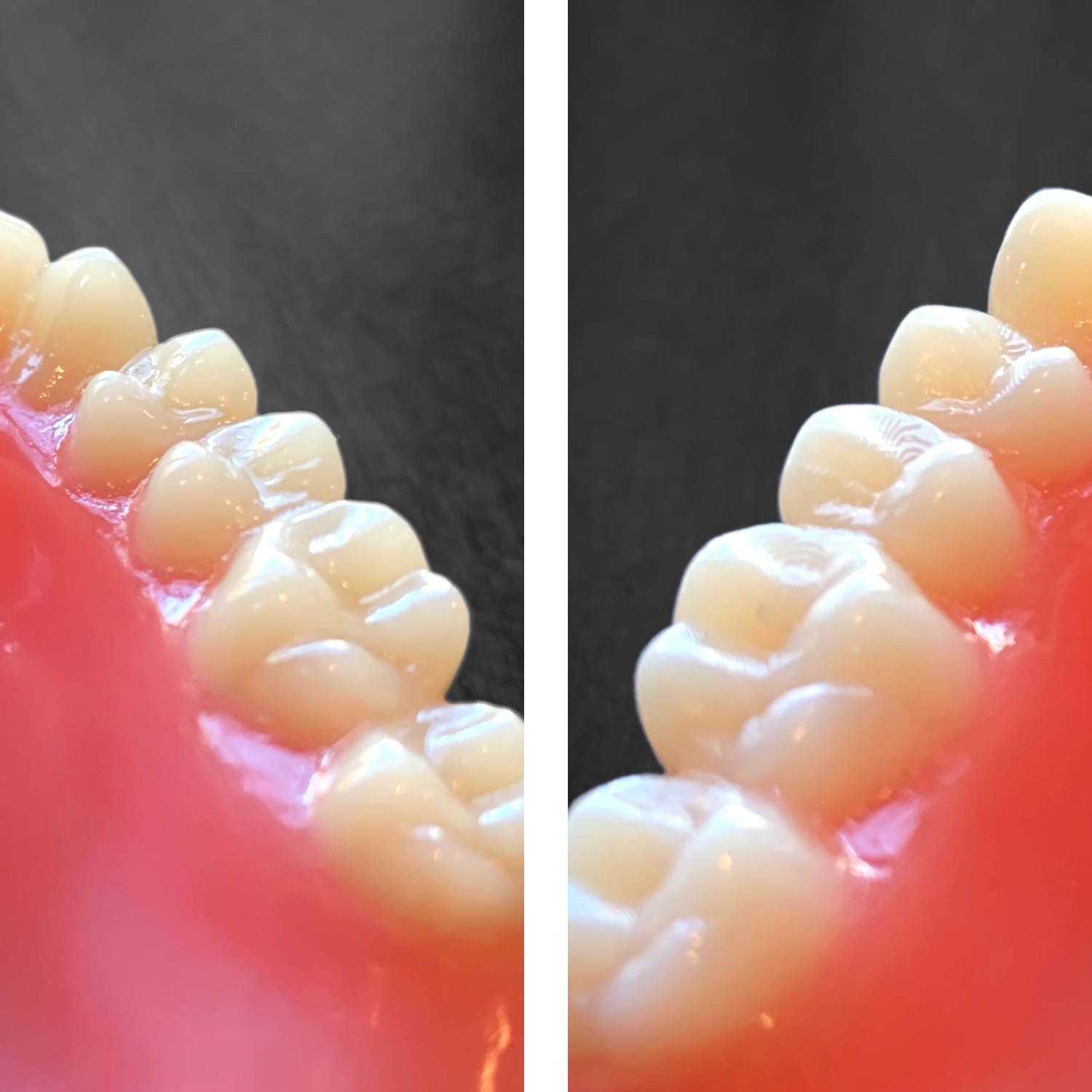
Milled prosthetic teeth (left) and printed prosthetic teeth. The layer-by-layer build-up of the printed teeth is clearly visible. These surface steps must be manually smoothed to minimise plaque retention.
In deciding on the appropriate equipment, the first consideration should be the intended application. 3D printers enable the large-scale and rapid production of diagnostic and working models, surgical guides and provisional restorations. However, for restorations intended for definitive placement, other factors are decisive: durability, biocompatibility and maximum precision for optimal fit. This is where milling technology has clear advantages.
Long-term studies confirm clinical reliability
Clinical validation gives patients, clinicians and laboratories confidence in the choice of technologies and materials. Materials used for milled restorations have a clear advantage in this respect: milled and ground dental ceramics have a clinical track record of more than 40 years of successful use. Long-term studies on lithium disilicate and zirconia crowns have confirmed their durability and clinical reliability.1, 2 In these studies, ceramic crowns demonstrated survival rates of more than 90% even after ten years. Comparable long-term clinical data for 3D-printed restorations remains limited, and direct comparisons over similar observation periods are not yet possible.
Milled crown (left) and 3D-printed crown. Milling leaves a small sprue in an inconspicuous position on the side of the restoration that can easily be removed by hand. In contrast, 3D printing requires thin supporting structures, which may be placed on functional or visible surfaces depending on the orientation and support strategy, making removal and finishing more difficult. Residual printing resin can be seen as a white film.
High flexural strength is a key factor for longevity
The flexural strength of the material used is an important factor in the longevity of a restoration. In this respect, 3D-printed resin materials still fall significantly short of milled ceramics. To improve mechanical performance, including flexural strength, some manufacturers have developed 3D-printing resins reinforced with ceramic fillers. These slurries may contain more than 50% ceramic by weight, but the remaining portion is still resin. Even with this reinforcement, crowns printed from hybrid resin achieve flexural strength values of approximately 80–150 MPa. By comparison, those milled from lithium disilicate and zirconia blocks can achieve flexural strength values of around 500 MPa and up to 1,200 MPa, respectively.
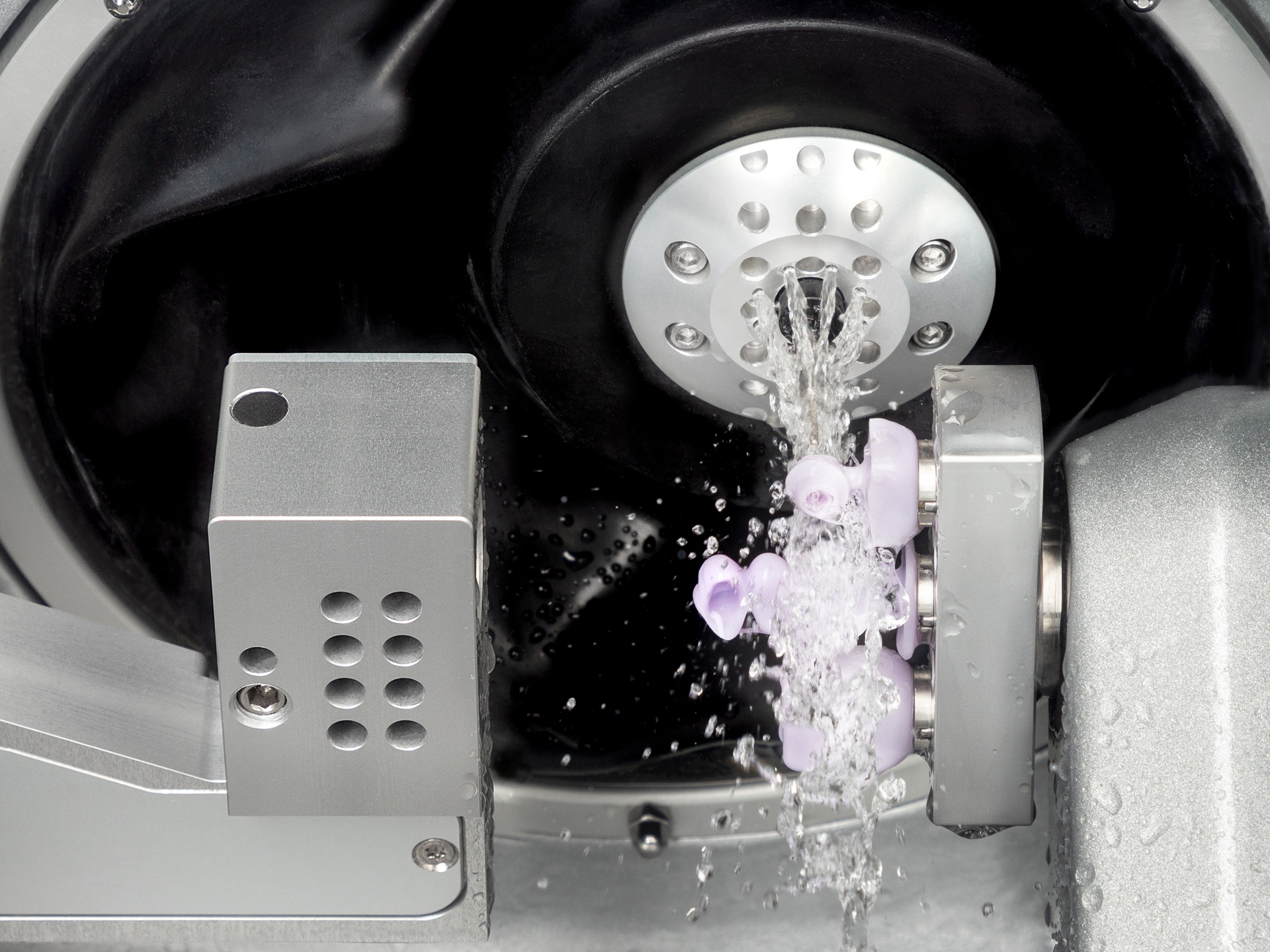
Wet grinding of glass-ceramic restorations in the milling unit.
Biocompatibility is a crucial factor
From the patient’s perspective, biocompatibility is arguably the most important factor. Both milling blanks and 3D-printing materials are specifically developed for dental applications and certified accordingly. However, their processing requirements differ significantly. 3D-printing resins often contain reactive components, such as acrylate monomers, and may also contain isocyanate-based components. In their liquid or insufficiently polymerised state, these materials may be toxic, irritating or sensitising. Precise and complete post-polymerisation is therefore essential, since insufficiently polymerised resin is considered a potential health risk. Moreover, in vitro studies have reported that certain 3D-printed resin materials may exhibit cytotoxic effects, depending on their composition and processing.3
Ceramic restorations remain the benchmark for quality and aesthetics
Tim Zinser is dental product manager at vhf camfacture, a leading manufacturer of milling machines, milling tools and compatible CAM software.
By contrast, materials used for milling and grinding have clinically proven biocompatibility: ceramic and metallic blanks are generally chemically stable. Milled restorations also provide an excellent surface finish, helping to minimise plaque accumulation. A properly milled and finished ceramic crown offers long-lasting aesthetics as well as the mechanical strength to reliably withstand daily functional loads—properties that 3D printing cannot currently match.
“All these considerations strongly support our commitment to continuously advancing milling technology,” said Tim Zinser, dental product manager at vhf camfacture. “Milled restorations deliver reliable, clinically proven results for laboratories and practices and their patients. Building on decades of development and manufacturing expertise, we remain committed to advancing our dental milling machines to ensure maximum precision and reliability today and in the future,” he continued.
According to Zinser, 3D printing can be a valuable addition to digital workflows in many cases and contributes to efficiency, particularly in the fabrication of guides and provisional restorations. He emphasised, however, that “when it comes to definitive restorations, milling technology using ceramic materials remains the undisputed benchmark”.
ATHENS, Greece: The research base for 3D printing of definitive restorations is fragmented across material classes, printing technologies and restoration ...
Advancements in hardware, software and materials science have meant that same-day 3D printing of dental prostheses—even chairside—is now a predicable ...
COLOGNE, Germany: When it comes to dental restorations, efficiency and aesthetics are two crucial factors that must be taken into consideration. With the ...
DALLAS, US: Researchers at The University of Texas at Dallas have introduced a novel approach to ceramic 3D printing that could streamline the production of...
In-house 3D printing is increasingly being used in dental clinics and laboratories as intra-oral scanners, CAD software, 3D printers, and printable resins ...
Digital workflows are constantly being improved with innovations in technique, software and materials and tailored to dental diseases and patient cases. ...
Running a dental practice is a multifaceted endeavour that requires not only excellent clinical knowledge but also a solid understanding of business. In ...
SENDAI, Japan: Using the exact same dataset and an industrial 3D digitiser to identify deviations, researchers at Tohoku University Graduate School of ...
Non-precious metal alloys are enjoying increased demand in dental technology. Additive manufacturing with laser melting ensures the uniformity and accuracy ...
Heidi Zisterer is a dental hygienist from Germany whose practice, White Line Dentistry in Tuningen, received an award for the country’s best dental ...
Education
Live webinar Mon. 26 October 2026 11:00 am EST (New York)
BOSTON, US: 3DDX, a US-based digital dentistry company, has announced the launch of 3DDX AI Planning, the first artificial intelligence (AI) implant ...
ASTANA, Kazakhstan: In September, MegaGen hosted the 2026 Eurasia Scientific Meeting in Astana, convening around 230 dental professionals from Kazakhstan ...



 Brazil / Brasil
 Canada / Canada
 Latin America / Latinoamérica
 USA / USA
 Austria / Österreich
 Bosnia and Herzegovina / Босна и Херцеговина
 Bulgaria / България
 Croatia / Hrvatska
 Czech Republic & Slovakia / Česká republika & Slovensko
 France / France
 Germany / Deutschland
 Greece / ΕΛΛΑΔΑ
 Hungary / Hungary
 Italy / Italia
 Netherlands / Nederland
 Nordic / Nordic
 Poland / Polska
 Portugal / Portugal
 Romania & Moldova / România & Moldova
 Slovenia / Slovenija
 Serbia & Montenegro / Србија и Црна Гора
 Spain / España
 Switzerland / Schweiz
 Turkey / Türkiye
 UK & Ireland / UK & Ireland
 China / 中国
 India / भारत गणराज्य
 Pakistan / Pākistān
 Vietnam / Việt Nam
 ASEAN / ASEAN
 Israel / מְדִינַת יִשְׂרָאֵל
 Algeria, Morocco & Tunisia / الجزائر والمغرب وتونس
 Middle East / Middle East

 Dr. Dimple DesaiRegister now1CELive webinar
 Dr. Ahmed ElmoghazyLive webinar
 Dr. Gil Asafrana D.M.D, B.M.ScRegister now1CELive webinar
 Dr. Adrian Gnatek PhD | Oral SurgeonRegister now1CE
















To post a reply please login or register