Relevance to dental manufacturing
In dental production, milling of ceramic implants and restorations from pre-sintered blanks results in substantial material loss. “Up to 90% of the blank can end up as milling waste, but the method continues to be used because every restoration is unique,” Dr Siebert said.
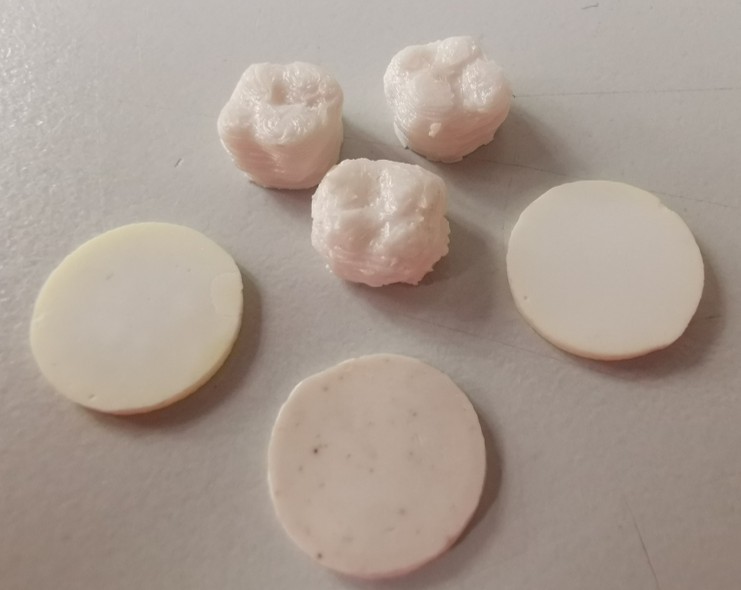
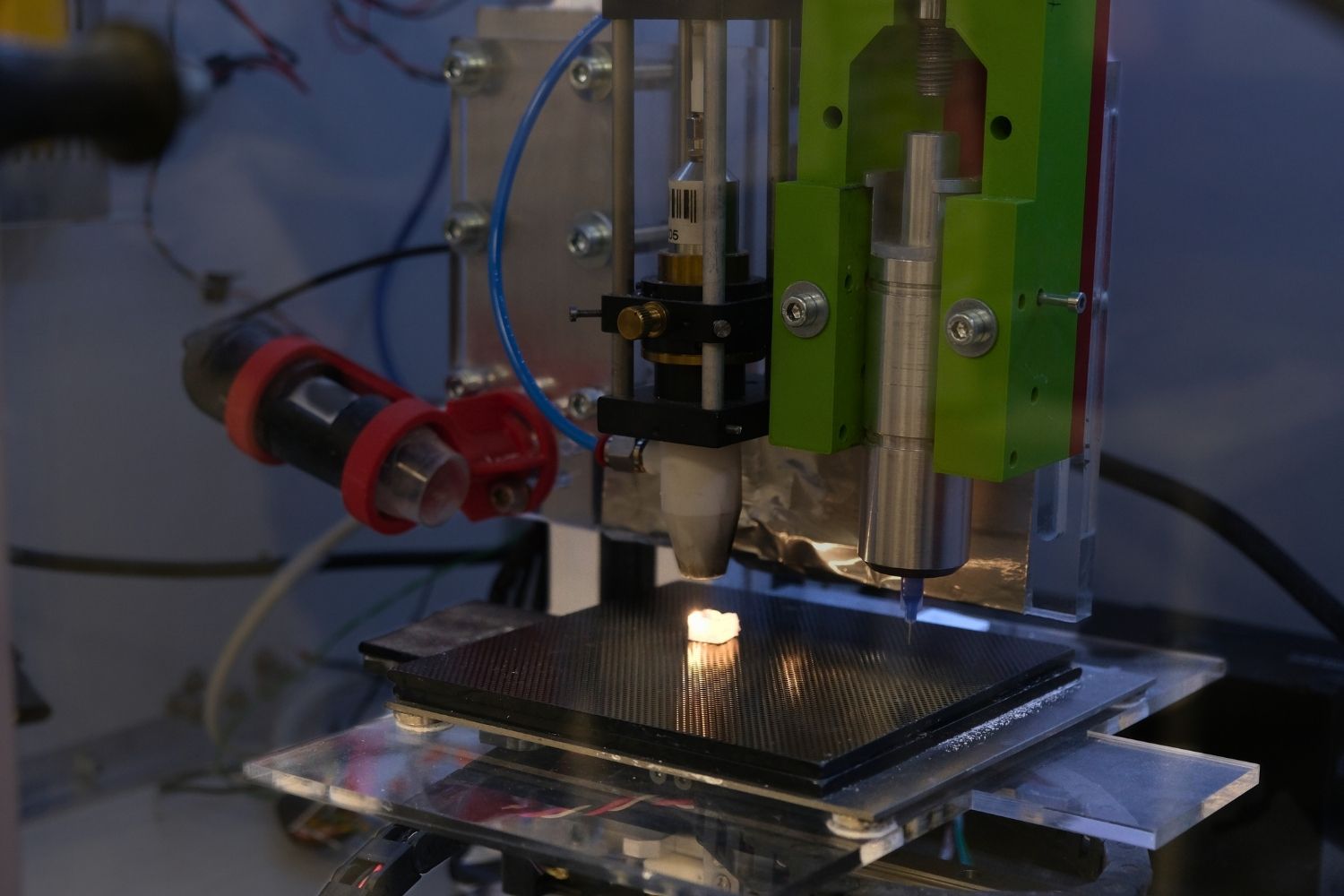
Although additive manufacturing significantly reduces waste, it usually still requires post-printing sintering in a furnace. “Using our process, a fully finished dental implant could emerge directly from the printer, perhaps requiring polishing but otherwise complete,” he said. Eliminating furnace sintering not only reduces energy consumption but also shortens the workflow.
Dr Siebert outlined a possible future scenario: “A dental implant could be ready within just a few hours using this process.” From a materials science perspective, a workflow involving an intra-oral scan in the morning and restoration that same day appears theoretically feasible.
Rethinking mechanics: Elastic microstructures
Beyond time and energy considerations, Dr Siebert highlighted the design freedom enabled by additive manufacturing. “Using conventional furnace processes, it is possible to achieve acceptable mechanical properties,” he said. “However, 3D printing offers the additional possibility of integrating elastic structures.”
An implant could exhibit a hard surface while maintaining a more elastic overall architecture, closer to the biomechanical behaviour of natural teeth. “Current implants are very rigid, which may contribute to wear of opposing natural teeth over time,” he said. Additive manufacturing could incorporate internal lattice-like features to reduce rigidity and help distribute forces more like natural teeth.
Optical properties as a design parameter
According to Dr Siebert, LAMP could also enable aesthetic customisation. By adjusting laser parameters, transparency and surface finish can be modified. The team also incorporated gold and silver ions into the printing ink, and these formed metallic nanoparticles during laser melting.
“These nanoparticles act like tiny optical filters. They allow specific wavelengths to pass through but block others,” Dr Siebert said. This means that colour perception can be influenced by the particles included and their size and distribution. The publication in Materials and Design demonstrates how optical properties can be deliberately tuned.
In dentistry, this could eventually enable patient-specific customisation with the aim of achieving restorations that are visually indistinguishable from natural dentition. “In the long term, it may even be possible to combine multiple ceramic pastes to precisely tailor colour and translucency,” Dr Siebert said.



 Brazil / Brasil
 Canada / Canada
 Latin America / Latinoamérica
 USA / USA
 Austria / Österreich
 Bosnia and Herzegovina / Босна и Херцеговина
 Bulgaria / България
 Croatia / Hrvatska
 Czech Republic & Slovakia / Česká republika & Slovensko
 France / France
 Germany / Deutschland
 Greece / ΕΛΛΑΔΑ
 Hungary / Hungary
 Italy / Italia
 Netherlands / Nederland
 Nordic / Nordic
 Poland / Polska
 Portugal / Portugal
 Romania & Moldova / România & Moldova
 Slovenia / Slovenija
 Serbia & Montenegro / Србија и Црна Гора
 Spain / España
 Switzerland / Schweiz
 Turkey / Türkiye
 UK & Ireland / UK & Ireland
 China / 中国
 India / भारत गणराज्य
 Pakistan / Pākistān
 Vietnam / Việt Nam
 ASEAN / ASEAN
 Israel / מְדִינַת יִשְׂרָאֵל
 Algeria, Morocco & Tunisia / الجزائر والمغرب وتونس
 Middle East / Middle East


 Dr. David Norré, Dr. Tommie Van de Velde DDS, MSc, PhDLive webinar
 Dr. Bruce McFarlane Certified Specialist in Orthodontics Fellow: Royal College of Dentists of Canada Diplomate: American Board of OrthodonticsRegister now1CELive webinar
 Linda Hecker MS, BSDH, RDHRegister now1CELive webinar

 Dr. Pär-Olov Östman, Dr. Robert Gottlander DDSRegister now1CE








To post a reply please login or register