Dr Elias Jean-Jacques Khoury is an oral surgery resident at Privatzahnklinik Schloss Schellenstein in Germany. He earned his dental degree from Johannes Gutenberg University Mainz in 2023 and is actively involved in oral surgery and implantology, with a focus on bone regeneration and soft-tissue management. (All images: Dr Elias Jean-Jacques Khoury)
Stable peri-implant soft tissue is an important factor in implant restorations that are successful both functionally and aesthetically. In this interview, Dr Elias Jean-Jacques Khoury discusses its clinical relevance and outlines practical, evidence-based concepts for soft-tissue management in implant dentistry.
“Soft-tissue management is not an optional add-on; it is an integral component of treatment planning.”
Dr Khoury, what are the primary goals of soft-tissue management today, and how does it influence clinical outcomes in relation to peri-implant health, aesthetics, patient comfort and long-term stability?
Implant dentistry has reached a high level of technical maturity in recent years. However, long-term success is strongly influenced by the quality and quantity of the peri-implant soft tissue. Beyond purely functional considerations, stability, cleansability and aesthetics have become key priorities. Therefore, soft-tissue management is not an optional add-on; it is an integral component of treatment planning before, during and after augmentation and implant placement.
In the pre-augmentation planning phase, how does your evaluation of the soft tissue influence the overall treatment plan and timing, and which soft-tissue augmentation procedures do you consider standard at this stage?
Within a pre-augmentation treatment concept, the primary focus is initially on rebuilding hard-tissue structures. However, establishing stable, well-vascularised soft-tissue conditions is a decisive prerequisite for successful bone augmentation. Free connective tissue grafts are a commonly used form of soft-tissue augmentation in this context, as they can be used in both the maxilla and mandible and provide reliable increases in peri-implant soft-tissue volume.
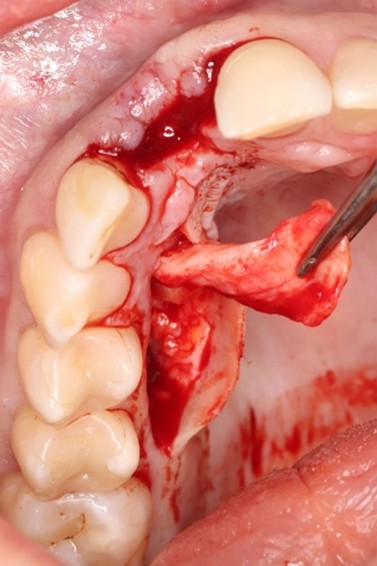
A pedicled palatal flap harvested from the palate for soft-tissue augmentation.
In severely compromised recipient sites, the advantages of a pedicled palatal connective tissue flap can be used. Because the graft remains pedicled to the palate, its vascularity is preserved, which can support improved integration and reduce postoperative shrinkage. When combined with augmentation procedures, this approach enables double-layer wound closure that helps protect the bony graft from dehiscence, exposure and infection. At the same time, it thickens the peri-implant soft tissue—an important benefit, particularly in the aesthetically critical maxillary anterior region. However, this technique is anatomically limited to the maxilla. As an adjunct, minimally invasive option, the soft-tissue punch technique may be used, especially after tooth extraction, to protect the blood clot and stabilise early soft-tissue healing.
What options are available for targeted soft-tissue management during implant placement and bone augmentation?
During implant placement and bone augmentation, incision design, flap mobilisation and suture positioning are critical for achieving tension-free wound closure. Tunnel and lateral tunnel techniques allow the suture line to be kept away from the augmented area, thereby reducing the risk of dehiscence.
A key challenge, particularly in the mandible, is the frequent lack of keratinised mucosa. In this setting, Kazanjian vestibuloplasty enables reconstruction of the vestibule and creation of keratinised, attached mucosa in a single-stage approach performed simultaneously with implant placement and augmentation. By selectively repositioning the muscle attachment and relocating the mucosa, a functionally stable, cleansable soft-tissue environment can be achieved.
As a more specialised refinement, the masseter-buccinator periosteal flap can be used in the posterior mandible. By providing double-layer wound closure, it may offer advantages in compromised recipient sites and reduce the risk of exposure of the augmented bone.
Clinical situation after vertical bone augmentation using the tunnel technique in the posterior mandible.
Correction of a shallow vestibule by Kazanjian vestibuloplasty, performed concurrently with implant placement.
Stable peri-implant soft tissue with an adequate zone of attached mucosa eight years after prosthetic rehabilitation.
“Proactive soft-tissue management will become an increasingly important hallmark of high-quality implant care.”
Which methods are suitable for soft-tissue management after implant placement?
After implant placement, the focus shifts to long-term stabilisation of the peri-implant tissues. Free mucosal grafts remain an established option for increasing the width of keratinised and attached mucosa. As an adjunct, apically positioned flaps—either alone or combined with connective tissue grafts—can be used to transpose keratinised mucosa vestibularly. Roll-flap techniques are particularly useful in the maxilla for horizontal soft-tissue volume gain and optimisation of the emergence profile. In the aesthetic zone, papilla reconstruction may be required; these measures are planned on an individual basis depending on defect morphology and the available soft-tissue volume.
Looking ahead, what developments do you expect to most influence implant dentistry, and what evidence or clinical needs are driving that change?
Modern implant dentistry is moving towards a biologically driven, comprehensive treatment concept. The clinical need is clear: long-term therapeutic success depends to a large extent on healthy, stable and cleansable peri-implant soft tissue. Therefore, proactive soft-tissue management will therefore become an increasingly important hallmark of high-quality implant care.
Editorial note:
This interview was published in implants—international magazine of oral implantology vol. 27, issue 1/2026. An edited version is provided here with permission from the publisher. Readers interested in learning more can follow the clinic’s Instagram account, where Dr Khoury and his father, Prof. Fouad Khoury, share professional expertise and insights into their clinical work.
Dr Giovanni Zucchelli is professor at the University of Bologna in Italy and president elect of the Italian Academy of Osseointegration. He specialises in ...
NEW YORK. U.S.: Minimally invasive dentistry has well and truly become a mainstream idea, and dental professionals around the world are dedicating countless...
NEW YORK, U.S.: The importance of soft tissue in implant dentistry is often underestimated. In an upcoming free Dental Tribune Study Club webinar on Friday,...
The aim of the present pilot case series study was to present a new technique for managing the periimplant soft tissue before implant placement, the ...
Implant dentistry has undergone a revolutionary transformation with the advent of digital workflows. These advancements have significantly improved the ...
Crestal bone stability around dental implants remains one of the most important features of successful implant treatment. Besides major clinical advantages ...
The use of aligner treatment led to the observation that molar extrusion seems to be prevented during dental movement by full daily use of aligners. This ...
PRAGUE, Czech Republic: Dental imaging can have consequences beyond its immediate clinical purpose, including its environmental footprint and unexpected ...
BRISBANE, Australia: Ensuring the formation of a solid soft-tissue seal at the dental abutment surface is crucial for protecting the underlying tissue from ...
Centuries ago, dentistry identified mineral deposits, such as calculus, as the main cause of dental disease. Further research then recognised bacterial ...
Education
Live webinar Tue. 13 October 2026 1:00 pm EST (New York)
RIYADH, Saudi Arabia: Although aligners can achieve occlusal improvements comparable to those of fixed appliances in selected cases, evidence is less ...
An International Team for Implantology (ITI) webinar to be hosted by Straumann Campus on 20 October will explore the key aspects of treating complex ...
SÃO PAULO, Brazil: Concerns about antimicrobial resistance and the limitations of adjunctive antibiotics have prompted research into other approaches to ...



 Brazil / Brasil
 Canada / Canada
 Latin America / Latinoamérica
 USA / USA
 Austria / Österreich
 Bosnia and Herzegovina / Босна и Херцеговина
 Bulgaria / България
 Croatia / Hrvatska
 Czech Republic & Slovakia / Česká republika & Slovensko
 France / France
 Germany / Deutschland
 Greece / ΕΛΛΑΔΑ
 Hungary / Hungary
 Italy / Italia
 Netherlands / Nederland
 Nordic / Nordic
 Poland / Polska
 Portugal / Portugal
 Romania & Moldova / România & Moldova
 Slovenia / Slovenija
 Serbia & Montenegro / Србија и Црна Гора
 Spain / España
 Switzerland / Schweiz
 Turkey / Türkiye
 UK & Ireland / UK & Ireland
 China / 中国
 India / भारत गणराज्य
 Pakistan / Pākistān
 Vietnam / Việt Nam
 ASEAN / ASEAN
 Israel / מְדִינַת יִשְׂרָאֵל
 Algeria, Morocco & Tunisia / الجزائر والمغرب وتونس
 Middle East / Middle East


 Dr. Pierre Marin, Dr. Antoine PopelutRegister now1CELive webinar
 Dr. Sinan GhishanRegister now1CELive webinar
 Dr. Sonia PresenciaLive webinar
 Dr. John Tsourounakis DDS, Cert. Perio, MS, FRCD(C)Register now1CE















To post a reply please login or register