Over the past decade, digital dentistry has significantly transformed prosthetic treatment workflows. Advances in intra-oral scanning and CAD/CAM subtractive and additive manufacturing technologies have improved the precision and predictability of restorative procedures. However, despite these developments, the digital prosthesis design stage remains a technical barrier for many clinicians and dental technicians. Conventional CAD systems often require complex interfaces and advanced operational skills, as well as manual construction of morphology. This can create a time burden in chairside environments where provisional and definitive restorations must be delivered efficiently.
Recently, CAD solutions based on artificial intelligence (AI) have emerged to address these limitations by simplifying the design process through automatic generation of prosthetic forms. This case report presents a single posterior crown treatment using an AI-based CAD solution and evaluates the clinical applicability and limitations of AI-driven design.
Case presentation
A 29-year-old male patient presented with a mesial carious lesion on tooth #37. Clinical examination and radiographic assessment confirmed structural compromise of the tooth, and a complete crown was indicated. After discussion of treatment options, a zirconia crown was selected as the definitive prosthesis. The patient expressed a preference for a digital chairside workflow to minimise chair time.
Chairside workflow
After administration of local anaesthesia, tooth preparation was performed in accordance with established crown preparation principles. Adequate occlusal and axial reduction were achieved to allow sufficient material thickness while preserving the remaining tooth structure.
After preparation, a digital impression was obtained using an intra-oral scanner (Medit i700). Because fabrication of the definitive zirconia restoration required additional time, a provisional restoration was planned to protect the prepared tooth and allow functional evaluation during the interim period.
The intra-oral scan data was imported via the cloud interface and prepared for crown design (Figs. 1a–d). The web-based AI CAD platform Dentbird Crown (Imagoworks) was used. The solution integrates with Medit Link, enabling direct cloud-based transfer of intra-oral scan data into the design environment without requiring separate software installation.
Fig. 1b: Import of intra-oral scan data into Dentbird Crown
Fig. 1c: Import of intra-oral scan data into Dentbird Crown
Fig. 1d: Confirmation of maxillary and mandibular datasets prior to AI design generation
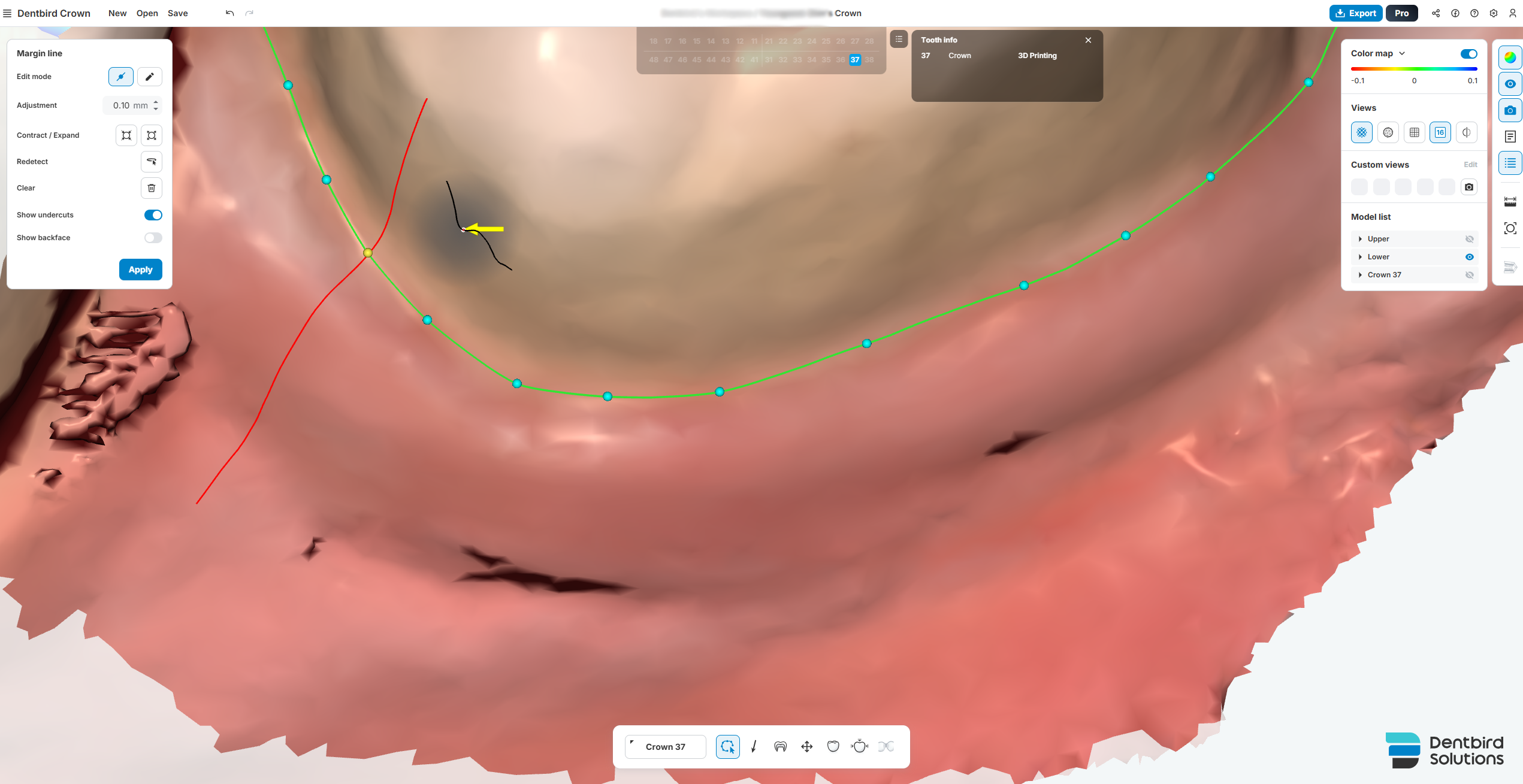
Fig. 2: Initial margin line detected by AI for tooth #37.
Fig. 3: Automatic margin detection with manual refinement to optimise marginal definition and the path of insertion.
After analysis of the uploaded scan, the AI system automatically identified the prepared tooth and detected the margin. A preliminary crown proposal was generated, and occlusal contacts were visualised using the colour map function (Fig. 2), allowing immediate evaluation of contact distribution.
The automatically detected margin was clinically reviewed. While it generally reflected the boundaries of the preparation, minor manual refinement was required to ensure precise adaptation, particularly in areas of irregular soft-tissue contour (Fig. 3). After adjustment, the margin definition was considered clinically acceptable.
The AI system then analysed adjacent tooth alignment and occlusal relationships and generated the crown morphology within a short period. The proposed form demonstrated contours harmonious with the adjacent dentition (Figs. 4a–d).
Fig. 4a: Evaluation of the AI-generated crown morphology. Occlusal contact distribution.
Fig. 4b: Assessment of proximal contact with the adjacent tooth.
Fig. 4c: Observation of the occlusion and contour from the buccal view.
Fig. 4d: Observation of the occlusion and contour from the lingual view.
The proximal and occlusal contacts were assessed. While the proximal contact was generally appropriate, certain cervical areas required modification to ensure an adequate path of insertion, and the occlusal surface required some refinement too. Digital sculpting tools were used to refine these proximal contact areas (Fig. 5a) and to refine the occlusal surface in order to achieve smoother and physiologically distributed contacts (Fig. 5b).
Fig. 5a: Refinement of the occlusal and proximal contacts using digital sculpting tools. Cervical contour modification to improve the path of insertion and marginal adaptation.
Fig. 5b: Occlusal surface refinement to optimise contact distribution.
Only limited modifications were necessary. Approximately 80% of the morphology was maintained as generated by the AI, and approximately 20% underwent fine adjustment (Figs. 6a–d). Compared with conventional CAD workflows that require complete manual morphology design, this approach reduced design time and simplified the overall process. From data upload to final design approval, the entire digital design stage was completed within a relatively short time. The design of the provisional restoration demonstrated clinically acceptable morphology and occlusal relationships.
Fig. 6a: Results after selective manual adjustments to the crown’s contact surfaces and occlusal contact distribution.
Fig. 6b: Manual refinement of the occlusal groove based on the AI-generated proposal.
Fig. 6c: Occlusal view showing the distribution and intensity of contacts with adjacent dentition.
Fig. 6d: Oblique view demonstrating the crown’s integration within the overall occlusal scheme.
The validated design data was then exported for fabrication (Fig. 7a). Accurate transfer of digital design data to the manufacturing stage is essential to prevent distortion or data loss. The isolated STL file was verified prior to production (Fig. 7b).
3D printing and milling
The STL file was exported directly to dedicated dental slicing software (CHITUBOX Dental) via the integrated export interface (Fig. 8a). The crown was positioned on the virtual build platform, and supporting structures were placed to minimise deformation during printing and to preserve marginal integrity (Fig. 8b).
The provisional crown was fabricated using a resin-based 3D printer (Sonic Mini 8K, Phrozen; Fig. 9), enabling rapid chairside production. Additive manufacturing allows efficient fabrication and accurate reproduction of complex anatomical details. In parallel, a second crown was milled from a PMMA block (Fig. 10). Subtractive manufacturing offers advantages in material homogeneity and surface stability and is widely used for long-term provisional or definitive restorations. Employing both methods allowed comparative evaluation of their clinical suitability.
Fig. 7a: Export of design data. Export interface showing the selection of crown #37 and preparation of the STL file for manufacturing.
Fig. 7b: Verification of the finalised crown design STL model for tooth #37 prior to fabrication.
Fig. 8a: Selection of CHITUBOX Dental during export to CAM software.
Fig. 8b: Crown positioned on the virtual build platform in CHITUBOX Dental with supporting structures applied prior to 3D printing.
Fig. 9: Sonic Mini 8K during fabrication of the provisional crown.
Fig. 10: Milling of a provisional crown from PMMA.
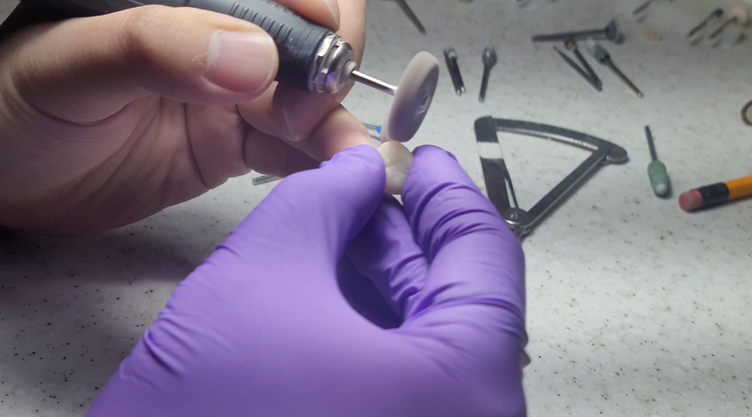
Fig. 11: Finishing and polishing of the 3D-printed crown using rotary instruments.
After fabrication, the crown surfaces were finished and polished using rotary instruments prior to intra-oral placement (Fig. 11). Surface finishing is essential not only for aesthetics but also for marginal adaptation, patient comfort and plaque control.
The 3D-printed provisional crown was selected for placement (Fig. 12a) and tried intra-orally to assess marginal adaptation, proximal contact and occlusal integration (Fig. 12b). The margin accurately reproduced the preparation boundary, and there was no overextension or detectable gaps. Proximal contact was clinically acceptable, and occlusal examination revealed no premature contact or functional interference. The provisional restoration was placed without additional adjustment.
At the one-week follow-up, marginal integrity, occlusal stability and soft-tissue response were evaluated. No inflammation or bleeding was observed, the surrounding soft tissue appeared healthy and masticatory function remained stable. Based on these findings, the same validated design was used to fabricate the definitive zirconia crown (Fig. 13).
The definitive zirconia crown was subsequently placed intra-orally (Fig. 14). Marginal adaptation remained stable, proximal contact was appropriate and occlusal contacts during centric occlusion and lateral excursions were within physiologically acceptable limits.
Fig. 12a: Completed 3D-printed provisional crown.
Fig. 12b: Try-in of the provisional crown on tooth #37.
Fig. 13: Definitive zirconia crown fabricated based on the validated digital design.
Fig. 14: Occlusal mirror view demonstrating integration and contact distribution.
Discussion
Advances in digital dentistry increasingly emphasise software-driven automation in addition to hardware development. AI has emerged as a valuable tool for supporting repetitive and experience-dependent design processes.
In this case, the AI-based system automated margin detection, morphology generation and occlusal analysis. The initial design demonstrated clinically acceptable adaptation and morphology, providing a reliable baseline for refinement. Particularly in routine cases such as single posterior crowns, AI-assisted design offers advantages in efficiency and consistency.
However, AI systems do not replace clinical judgement. In cases involving complex occlusal schemes or multiple missing teeth, additional manual modification may be required. Final assessment of fit, function and aesthetics remains the responsibility of the clinician. AI-based CAD systems should therefore be regarded as supportive tools that enhance efficiency during the initial design stage. Optimal outcomes are achieved when automated design capabilities are integrated with clinical expertise.
CAD/CAM technology allows dental professionals to manufacture solid all-ceramic crowns chairside. A digital image of the preparation is captured with an ...
The digital revolution in dentistry has introduced increasingly efficient and predictable workflows, enabling clinicians to drastically reduce treatment ...
SEOUL, South Korea: Imagoworks, a South Korean company that specialises in artificial intelligence (AI) and cloud-based digital dentistry solutions, ...
CZĘSTOCHOWA, Poland: Conventional digital orthodontic set-ups often focus primarily on crowns. Although this approach supports aesthetic and occlusal ...
A 38-year-old female patient presented to our dental practice complaining of discomfort in the maxillary left area. The clinical examination revealed a ...
Digital dentistry has transformed restorative and aesthetic treatment. Technologies such as intra-oral scanning, digital smile design and chairside ...
HONG KONG: CAD/CAM technology has greatly improved the productivity of dental prostheses but still has its drawbacks when it comes to the design of crowns....
The latest generation of two-piece ceramic implants (zirconia) is considered an alternative treatment option to titanium implants owing to their excellent ...
This article describes and demonstrates the use of the Erbium:YAG 2940nm laser system (LiteTouch, Syneron Medical Ltd.) as a central tool in the treatment ...



 Brazil / Brasil
 Canada / Canada
 Latin America / Latinoamérica
 USA / USA
 Austria / Österreich
 Bosnia and Herzegovina / Босна и Херцеговина
 Bulgaria / България
 Croatia / Hrvatska
 Czech Republic & Slovakia / Česká republika & Slovensko
 France / France
 Germany / Deutschland
 Greece / ΕΛΛΑΔΑ
 Hungary / Hungary
 Italy / Italia
 Netherlands / Nederland
 Nordic / Nordic
 Poland / Polska
 Portugal / Portugal
 Romania & Moldova / România & Moldova
 Slovenia / Slovenija
 Serbia & Montenegro / Србија и Црна Гора
 Spain / España
 Switzerland / Schweiz
 Turkey / Türkiye
 UK & Ireland / UK & Ireland
 China / 中国
 India / भारत गणराज्य
 Pakistan / Pākistān
 Vietnam / Việt Nam
 ASEAN / ASEAN
 Israel / מְדִינַת יִשְׂרָאֵל
 Algeria, Morocco & Tunisia / الجزائر والمغرب وتونس
 Middle East / Middle East

 Prof. Dr. Gustavo De-DeusLive webinar
 Dr. Dimple DesaiRegister now1CELive webinar
 Dr. Ahmed ElmoghazyLive webinar
 Dr. Gil Asafrana D.M.D, B.M.ScRegister now1CE












To post a reply please login or register