A non-invasive, functionally guided approach can predictably correct early posterior crossbite and support physiological craniofacial development in paediatric practice. (Image: kapinon/Aobe Stock; clinical images: Dr Alessandro Carrafiello)
Numerous clinical studies confirm that maxillary transverse deficiency is among the most common orthodontic and skeletal problems in childhood and is frequently associated with posterior crossbite.1 The prevalence of posterior crossbite in children under 8 years of age is close to 10%.1, 11 When edge-to-edge dental relationships are also included, the prevalence of posterior transverse occlusal discrepancies is likely higher. This malocclusion has been strongly associated with dysfunction and parafunctional habits, which represent a significant aetiological component of maxillary transverse deficiency.2, 6–8
It has also been widely demonstrated that craniofacial sutures are sensitive to cyclic forces and that these forces influence suture histology when applied at specific physiological frequencies. Based on clinical experience, cyclic forces applied to the facial bones induce significant skeletal and morphological changes, particularly in growing patients.2, 9, 10
The aim was therefore to design a device capable of treating posterior crossbite while simultaneously restoring function by combining constant, incrementally increased transverse forces with cyclic forces. Because the first ten to 12 years of life are critical for the integration of orofacial motor patterns into motor, postural, respiratory, lingual and expressive functions, the device was designed to maximise tongue space while minimising bulk and invasiveness, a fundamental requirement of the technique.
The system
Essentially, the treatment approach combines a series of thermoformed devices with progressively increased transverse dimensions—Nuvola SPRINT arch conformers—with a soft device, the Freedom Mini (both G.E.O. Italy; Fig. 1). These conformers are not intended to align teeth, but rather to guide transverse expansion of constricted arches. While wearing the conformer, the paediatric patient performs cyclic clenching of the Freedom Mini between the arches. In this way, the system combines the constant forces generated by the conformer with the cyclic forces produced by clenching of the myofunctional Freedom device.
The Nuvola SPRINT arch conformer
The flexible Nuvola SPRINT arch conformers are designed using dedicated software. The arch conformers are customised based on the patient’s 3D arch model, and an average expansion of 0.50 mm is performed per phase (0.25 mm per quadrant). The Nuvola SPRINT conformer leaves the canine-to-canine segment uncovered, as well as the area posterior to the incisive papilla, including the incisive foramen and the first two palatal rugae. To ensure sufficient rigidity, two digitally integrated transpalatal bars are incorporated into the design (Figs. 2 & 3). Their shape and position allow limited torsion and flexion during clenching with the Freedom Mini.
Fig. 1: Combination of forces.
Fig. 2: Nuvola SPRINT arch conformer.
Fig. 3: Nuvola SPRINT arch conformer in position.
Additional patented features include two lingual pins that encourage exploratory tongue contact. For the pin to function as an effective sensory stimulus, its size must correspond to the discrimination range of the filiform papillae receptors (approximately 1–2 mm). If the pin is too small, it may not be detected by pressure receptors and may go unnoticed or be eliminated from proprioceptive pathways after initial contact. If it is too large, after an initial exploration, it may be perceived as part of the normal oral anatomy and subsequently be ignored. When sized at about 1.4 ± 0.2 mm, the pins are consistently explored by the tongue, producing beneficial functional effects.3, 12
Fig. 4: Freedom Mini.
Stability is ensured through palatal attachments, allowing close adaptation to the palate without restricting tongue mobility during speech or swallowing. Proprioception in the anterior third of the palate remains largely unaffected, making the therapy minimally invasive.
The Freedom Mini
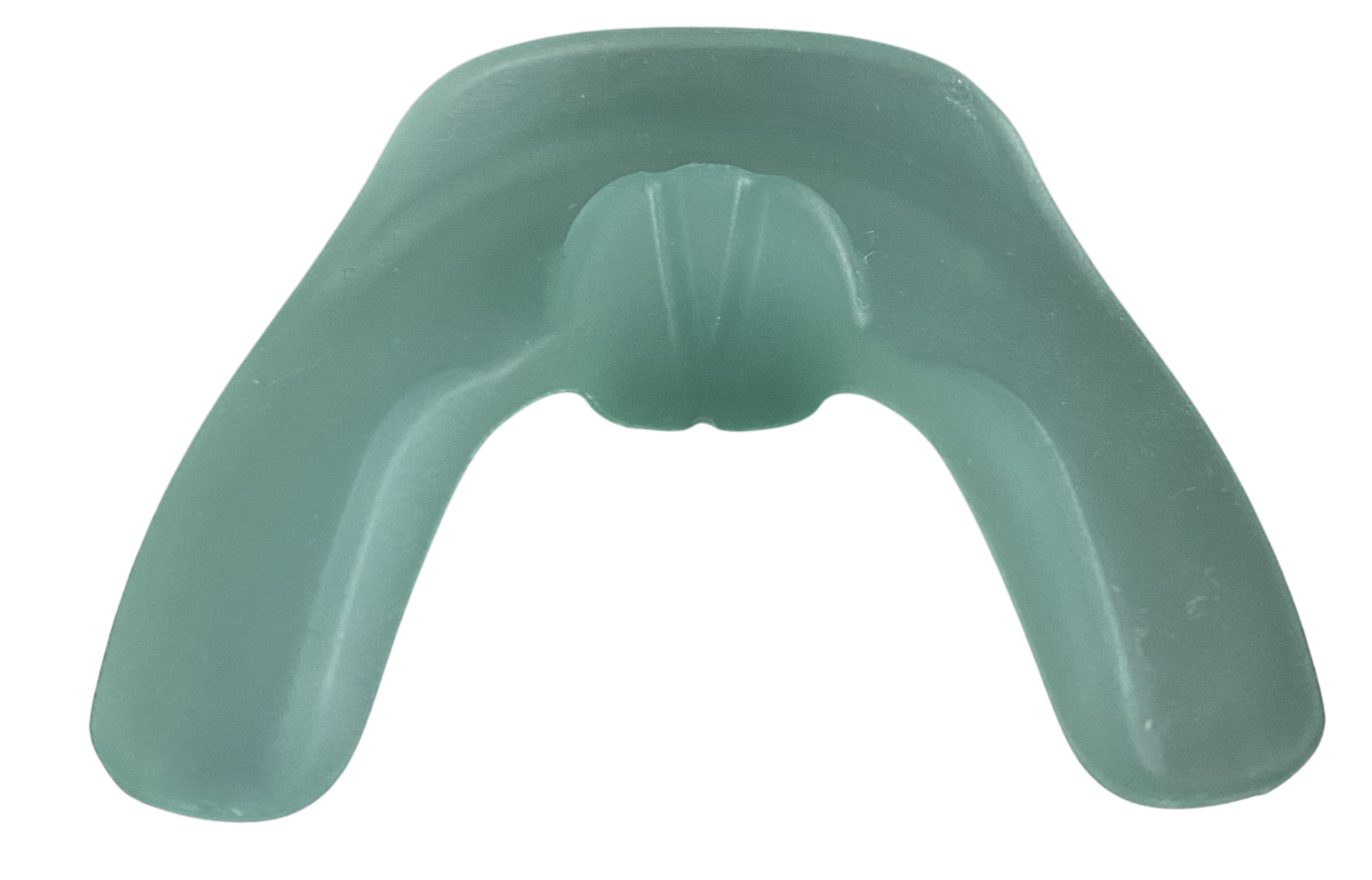
The Freedom Mini was developed using specific tested and patented components (Fig. 4). It is a myofunctional device designed to be chewed; it is not an orthodontic appliance per se and does not remain in the oral cavity for prolonged periods. The device incorporates several distinctive functional features:
alternating vestibular and lingual flanges that allow torsion during clenching, essential for managing morphological asymmetries;
a frontal shield to modulate perioral muscle activity and promote nasal breathing;
a lingual ramp with vertical, divergent grooves that guide the tongue towards the lingual pins positioned lateral to the incisive papilla (corresponding to the palatal spot); and
a calibrated material hardness designed to induce muscular contraction.
Muscle exercises
The conformer is worn for at least 16 hours per day. The Freedom Mini is worn for 30 minutes per day while the paediatric patient performs cyclic clenching with the conformer in place. The child performs the exercise with the lips closed. In oral breathing patients with marked hypotonia or low stamina, a continuous 30-minute session may be overly fatiguing; in such cases, the exercise may be divided into two 15-minute sessions.
Cyclic clenching of the Freedom Mini, performed in disclusion, activates the muscles of mastication, particularly the pterygoid muscles. Owing to their anatomical orientation, these muscles contribute to adaptive transverse expansion of the palate. The force generated by the muscles of mastication is evenly distributed across the conformer. Its thickness and plastic composition allow controlled torsion and flexion, which are essential for biomechanical action on the palatine sutures and surrounding areas. Simultaneously, the tongue is guided anteriorly towards the lingual pins while the lips remain closed. Together, these mechanisms provide effective myofunctional and adaptive support for dysfunction associated with reduced palatal width.
Clinical experience includes over three years of application in collaboration with the Bambino Gesù Children’s Hospital in Rome in Italy. Two cases are presented to illustrate the system’s morphological and functional potential.
Figs. 5a & b: Facial photographs at the beginning of treatment: profile view (a); frontal view (b).
Fig. 6a: Initial intra-oral photographs: right lateral view of the posterior crossbite.
Fig. 6b: Frontal view.
Fig. 6c: Left lateral view.
Fig. 7a: Final photographs: right lateral view.
Fig. 7b: Frontal view.
Fig. 7c: Left lateral view.
Figs. 8a & b: Palatal models before (a) and after the therapy (b) with width measurements: from 33.52 mm to 36.73 mm in inter-canine width and from 38.37 mm to 42.47 mm in inter-molar width.
Figs. 9a & b: Lateral cephalograms before (a) and after therapy (b).
Fig. 10a: Intra-oral photographs at the 24-month follow-up: right lateral view.
Fig. 10b: Frontal view.
Fig. 10c: Left lateral view.
Fig. 11a: Facial photographs at the 24-month follow-up: frontal view.
Fig. 11b: Profile view.
Case 1
An 8-year-old child presented with bilateral anterior crossbite, oral breathing, deficient growth of the middle third of the face and inclined frontal posture, which was part of the child’s habitual postural pattern (Figs. 5a–6c). Owing to the consequent impairment of tongue and respiratory function, the combined use of the Nuvola SPRINT arch conformer and the Freedom Mini was selected because it supports respiratory functional recovery while interfering only minimally with tongue space. Through 30 minutes of daily Freedom Mini use, nasal breathing is promoted, thereby initiating respiratory re-education.
A series of 12 conformers were fabricated, and the sixth conformer was duplicated to ensure better overall adaptation and smoother progression of therapy. The conformer was changed every five days. From the start of therapy, the child consistently used the Freedom Mini for 30 minutes per day while wearing the conformer (Figs. 7a–c).
The initial and final measurements showed an increase in inter-canine of more than 3 mm and in inter-molar width of more than 4 mm (Figs. 8a & b). Comparison between the initial and final lateral cephalograms demonstrated rapid functional respiratory improvements, evidenced by reduction of adenoidal tissue and increased dimensions of the upper airway (Figs. 9a & b). An improvement in antero-posterior relationships was also observable. The results remained stable after 24 months (Figs. 10a–11b).
Fig. 12a: Initial facial photograph: frontal facial view showing asymmetry of the eyes and auricular exposure.
Fig. 12b: Initial facial photograph: frontal facial view during smiling, showing persistence of asymmetries.
Fig. 13a: Initial intra-oral photograph: right lateral view.
Fig. 13c: Initial intra-oral photograph: left lateral view.
Figs. 14a & b: Palatal models before (a) and after the therapy (b) with width measurements: from 23.56 mm to 28.00 mm in inter-canine width and from 28.80 mm to 33.20 mm in inter-molar width.
Fig. 15: Frontal intra-oral photograph at the end of treatment.
Figs. 16a &b: Facial comparison before treatment showing harmonisation of proportions.
Case 2
The patient was 5 years old and presented with severe palatal constriction on the right, as well as with mandibular deviation, and early asymmetry of facial expression and postural alignment of the head, neck and shoulders (Figs. 12a & b). She also presented with asymmetry of auricular exposure, reflecting temporal bone involvement within a dysfunctional cranial pattern. She presented with crossbite on the right, beginning at the lateral incisor, indicative of contraction of the entire right palate and of mandibular midline deviation (Figs. 13a–c).
The Nuvola SPRINT protocol was applied, involving fabrication of ten conformers and duplication of the sixth and clenching of the Freedom Mini for 30 minutes per day with the lips closed. After 40 days, the results were an increase in inter-canine width of more than 4 mm and in inter-molar width of more than 4 mm, complete resolution of the dentoalveolar crossbite (Figs. 14a & b), improvement of orofacial motor patterns and facial symmetrisation (Figs. 15–16b).
Final considerations
This method demonstrates high ease of use and predictability. Impression taking is simplified, requiring only digital scans of both arches and placement of a limited number of palatal attachments for stability. By monitoring patient compliance with daily use of the Freedom Mini, planned outcomes can be achieved consistently.
In both cases presented, complete resolution of the crossbite occurred within the planned time frame, relying solely on diligent use of the Nuvola SPRINT conformers in combination with the myofunctional device. The cases were selected because of their associated dysfunction—respiratory dysfunction in the first case and postural dysfunction along with facial asymmetry in the second. In both, excellent functional outcomes were obtained, attributable to features such as lingual pins, controlled flexibility and preserved intra-oral space, all of which support physiological function.
The gentleness of the method allows for very early interceptive treatment, including of patients under 5 years of age. Beyond transverse palatal expansion, morphological and functional correction guides development towards physiological patterns. Its non-invasiveness, effectiveness and short treatment duration make it well suited for routine early interceptive orthodontic and orthopaedic practice, particularly for clinicians attentive to orofacial motricity.
The second most common dental agenesis is that of the maxillary lateral incisors, after agenesis of the mandibular third molars.1 This common agenesis has ...
The purpose of this article is to show the diferent modalities of treatment for upper lateral incisors agenesis. In daily practice, orthodontists often meet...
Prosthetically driven implant placement has become a fundamental principle in contemporary implant dentistry, particularly in the treatment of edentulous ...
Maxillary second molars are always a challenge for root canal therapy. This difficulty is related to the location of the tooth, way back in the maxilla with...
Digital workflows in dentistry have revolutionised how clinicians approach complex procedures, enhancing precision, efficiency and patient outcomes. Among ...
Porcelain-fused to metal crowns have been commonly used since their introduction in the 1960s.1 The presence of a metallic substructure confers certain ...
Full-arch implant-supported fixed protheses have become a highly desired solution for the rehabilitation of patients with terminal dentition or completely ...
Successful immediate implant placement associated with immediate loading remains one of the greatest clinical challenges. In addition to the placement of an...
Anti-ageing is a branch of medicine focused on how to prevent, slow or reverse the effects of ageing, thus helping people to live longer and healthier ...
A metal–acrylic hybrid prosthesis has traditionally been a popular choice for implant-supported full-arch prostheses. More recently, zirconia has come to ...
Education
Live webinar Mon. 26 October 2026 11:00 am EST (New York)



 Brazil / Brasil
 Canada / Canada
 Latin America / Latinoamérica
 USA / USA
 Austria / Österreich
 Bosnia and Herzegovina / Босна и Херцеговина
 Bulgaria / България
 Croatia / Hrvatska
 Czech Republic & Slovakia / Česká republika & Slovensko
 France / France
 Germany / Deutschland
 Greece / ΕΛΛΑΔΑ
 Hungary / Hungary
 Italy / Italia
 Netherlands / Nederland
 Nordic / Nordic
 Poland / Polska
 Portugal / Portugal
 Romania & Moldova / România & Moldova
 Slovenia / Slovenija
 Serbia & Montenegro / Србија и Црна Гора
 Spain / España
 Switzerland / Schweiz
 Turkey / Türkiye
 UK & Ireland / UK & Ireland
 China / 中国
 India / भारत गणराज्य
 Pakistan / Pākistān
 Vietnam / Việt Nam
 ASEAN / ASEAN
 Israel / מְדִינַת יִשְׂרָאֵל
 Algeria, Morocco & Tunisia / الجزائر والمغرب وتونس
 Middle East / Middle East
 Dr. Dimple DesaiRegister now1CELive webinar
 Dr. Ahmed ElmoghazyLive webinar
 Dr. Gil Asafrana D.M.D, B.M.ScRegister now1CELive webinar
 Dr. Adrian Gnatek PhD | Oral SurgeonRegister now1CE










To post a reply please login or register