Felix Paul Wright, a master dental technician in Germany, says that the increasing use of artificial intelligence may help to ease workforce pressures in dental laboratories. (All images: Marc Fippel/Dentsply Sirona)
Felix Paul Wright is a master dental technician in Germany specialising in digital workflows and implant prosthetics. At Dentsply Sirona World Germany, held in Bonn in March, Wright spoke with Dental Tribune International about his journey into digital dentistry, the advantages of fully integrated workflows within a clinical setting, and how close collaboration between technicians and clinicians can improve efficiency and patient outcomes. He also shared insights into the growing role of 3D printing and artificial intelligence (AI) in shaping the future role of dental technicians.
Mr Wright, can you tell us about your professional journey in dental technology and what sparked your interest in digital dentistry? I started my career in dentistry in 2006 with an apprenticeship, and completed my dental technician training in 2010. In 2017, I became a certified master dental technician. At an early stage of my apprenticeship, I had the opportunity to begin working with CAD/CAM systems. These were the very first CAD/CAM technologies in the laboratory, and I immediately recognised the enormous potential of digital dentistry. I was hooked on the technology right away.
My long-standing passion for computer games and working in 3D digital environments gave me a natural advantage. Combining this existing affinity with solid dental knowledge gave me an excellent foundation, and I simply loved it from the very beginning. Today, my main focus lies on implant prosthetics, complex reconstructions and fully digital workflows. This includes areas such as intra-oral scanning, implant planning, fully automated monolithic restorations and smile design.
“For me, digital dentistry is far more than just a tool.”
Would you describe digital dental technologies as another tool in your toolbox?
For me, digital dentistry is far more than just a tool. It represents the most efficient and predictable way to deliver consistently high-quality aesthetic and functional results for patients and clinicians.
You manage a laboratory situated within a dental practice environment*. How is the digital workflow set up in the practice and how does close collaboration between dental and laboratory staff influence efficiency and treatment outcomes?
We operate in a fully digital workflow, using digital technologies to master every stage from design to CNC milling and right up to 3D printing. We work very closely with our dentists. If they have a problem, we as technicians can support them—whether with CNC milling machines or intra-oral scanners.
Working so closely together helps to make the team very efficient. For example, we usually receive scan data by late morning, and then we produce the crowns by 4 PM. The treatment team can place the crowns on the same day and the patient benefits immediately. The proximity helps us to deliver same-day dentistry.
Implantology is increasingly driven by digital technologies. How has digital planning changed your approach to implant-supported prosthetics? It has had a big impact. By involving everybody in the implant planning phase, we are able to thoroughly address the patient case from the very beginning. This makes producing the restoration much simpler for the dental technicians in the laboratory, as the implant positions are already aligned precisely with the requirements and later restorations.
In our practice, everyone involved reviews the case before treatment is carried out. The technician contributes their input, the clinicians add theirs, and as a result, the entire team has a clear understanding of how the case is progressing at each stage. This shared visibility helps prevent miscommunication and allows potential issues to be addressed early.
“We have nine 3D printers on site, and they have had a significant impact on how we work and the final results.”
It also creates a more efficient workflow supported by the right technology. The technician can confirm the ideal position of the crown, while the clinicians ensure the implant is correctly placed in the bone. By aligning these perspectives from the outset, we can work more predictably and deliver better outcomes for the patient. Ultimately, achieving that alignment between the restorative and surgical aspects is the main goal.
3D modelling plays a central role in modern dental technology. What developments in CAD design and digital modelling have had the greatest impact on your workflow in recent years?
For me, the greatest impact on our workflow has not come via software environments, it has come via the development and application of dental 3D-printing technologies. CAD software has shown high capabilities for several years. However, whereas milling is especially strong for many established materials and indications, 3D printing supports more complex designs, so it has had a real impact on the entire design process. We have nine 3D printers on site, and they have had a significant impact on how we work and the final results.
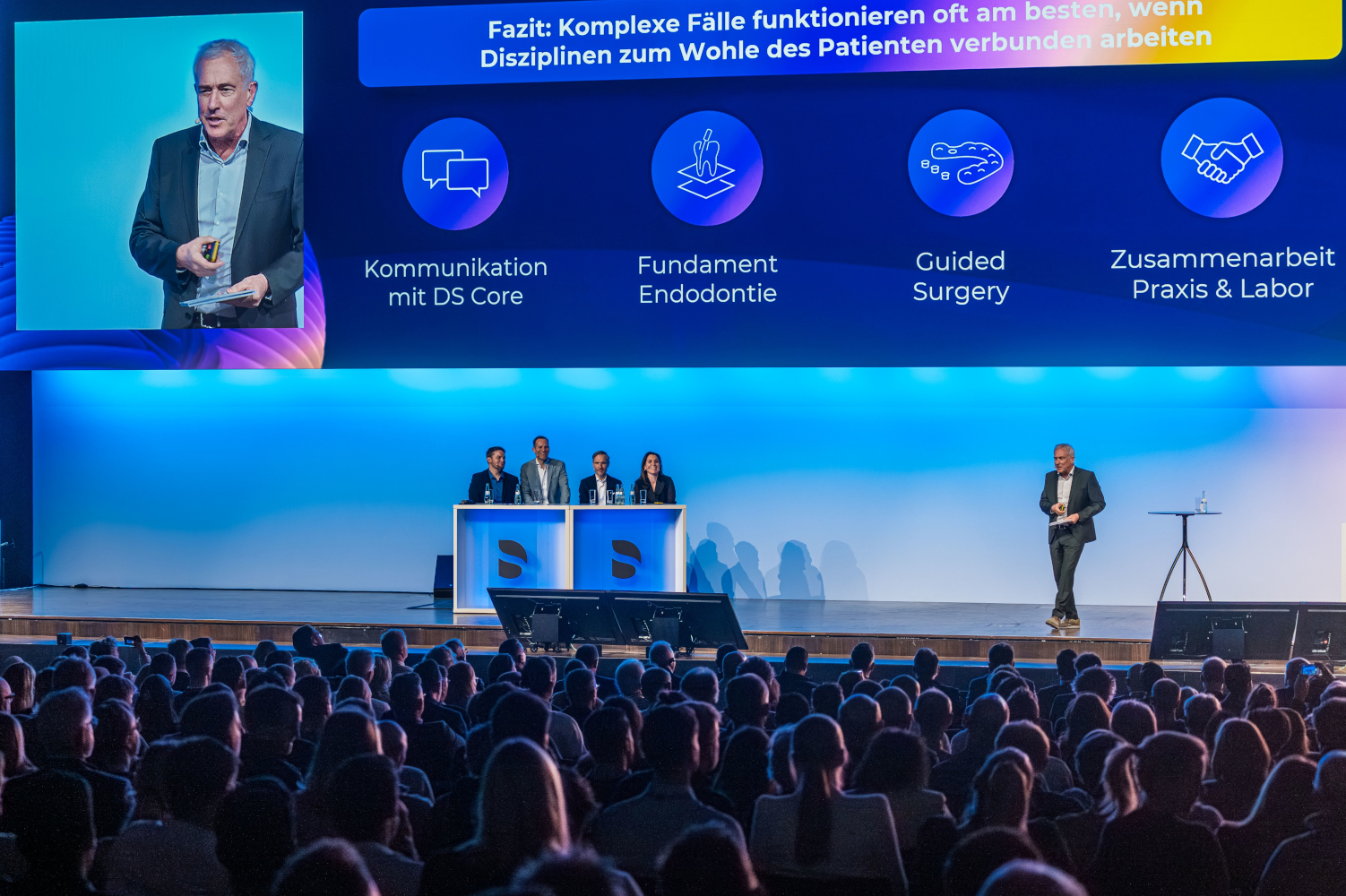
At DS World Germany in March, Felix Paul Wright (left) shared insights on connected dentistry in dental laboratories as part of a panel discussion moderated by Prof. Rainer Seemann (right), chief clinical officer at Dentsply Sirona.
At DS World Germany in Bonn, you presented the workshop “The digital dimension: denture manufacturing in a modern workflow”. What were some of the key concepts and insights from this session? In my workshop, I demonstrated which indications can be addressed in the field of digital prosthetics, and what the main goals are. Thus, through digitalisation, we as dental technicians are once again able to make complete dentures profitable and attractive. What many dental professionals overlook is that with the Lucitone material we have a high-quality substance with which the prostheses can also be relined in a validated process using Lucitone HIPA (PMMA).
Furthermore, I showed attendees a few examples of cases using Lucitone Digital Print Denture Workflow from Dentsply Sirona. Lucitone is particularly effective here, owing to the strength of the restorations delivered, and the ability to optimally integrate interim prosthetics into the workflow.
Looking ahead, how do you see digital manufacturing technologies shaping the future role of dental technicians in implant prosthetics and denture fabrication? Digital tools will continue to change how dental technicians work, improving the delivery of treatment and patient care. Looking forward, above all, I think that AI will play a much bigger role in digital workflows in the future. One of the main reasons for this is that the technology helps to speed up the design process, which ultimately gives dental technicians more time for assembling and finalising restorations. This could have a bigger impact than people realise, owing to the ongoing shortage of trained dental technicians in Germany. Currently, there are not enough young people entering the profession. With the help of AI, digital technologies could allow us to treat more cases with fewer staff. I think it really is the future.
Editorial note:
* Zahnmedizinisches Zentrum (ZMZ) Westpfalz operates one clinic in Mehlingen and one in Kaiserslautern, both located in southwest Germany.
For generations, dental technicians have been the quiet architects behind every confident smile. Working behind the scenes in laboratories, technicians ...
TOKYO, Japan: Set for 3 and 4 October in Tokyo, the sixth GC International Dental Symposium will bring together general practitioners, specialists, dental ...
SCHAAN, Liechtenstein: Ivoclar has announced the launch of IPS e.max Zirconia. This latest addition to the IPS e.max family expands the possibilities for ...
3D printing using resins has become an important part of dental workflows, but the materials, printer operation and post-processing may pose inhalation ...
AURORA, Colo., US: Multi-material 3D-printing of monolithic dentures in a single build has been a significant advance in digital denture fabrication. ...
JINAN, China: 3D printing of lithium disilicate still faces challenges in achieving precise results. The material’s high transparency allows laser light ...
CHARLOTTE, N.C., US: Dentsply Sirona has announced that registration is now open for Dentsply Sirona (DS) World Las Vegas 2026, which will take place on ...
In Bonn, the first Dentsply Sirona World Germany brought together dental professionals to explore the growing role of connected digital technologies in ...
Education
Live webinar Wed. 21 October 2026 11:00 am EST (New York)



 Brazil / Brasil
 Canada / Canada
 Latin America / Latinoamérica
 USA / USA
 Austria / Österreich
 Bosnia and Herzegovina / Босна и Херцеговина
 Bulgaria / България
 Croatia / Hrvatska
 Czech Republic & Slovakia / Česká republika & Slovensko
 France / France
 Germany / Deutschland
 Greece / ΕΛΛΑΔΑ
 Hungary / Hungary
 Italy / Italia
 Netherlands / Nederland
 Nordic / Nordic
 Poland / Polska
 Portugal / Portugal
 Romania & Moldova / România & Moldova
 Slovenia / Slovenija
 Serbia & Montenegro / Србија и Црна Гора
 Spain / España
 Switzerland / Schweiz
 Turkey / Türkiye
 UK & Ireland / UK & Ireland
 China / 中国
 India / भारत गणराज्य
 Pakistan / Pākistān
 Vietnam / Việt Nam
 ASEAN / ASEAN
 Israel / מְדִינַת יִשְׂרָאֵל
 Algeria, Morocco & Tunisia / الجزائر والمغرب وتونس
 Middle East / Middle East

 Dr. Ronald JungLive webinar
 Prof. Aylin Baysan BDS MSc PhD MFDS RCSEd MEndo RCSEd FDTFEd FDS RCSEng PHEARegister now1CELive webinar
 Prof. Dr. Gustavo De-DeusLive webinar
 Dr. Dimple DesaiRegister now1CE









To post a reply please login or register